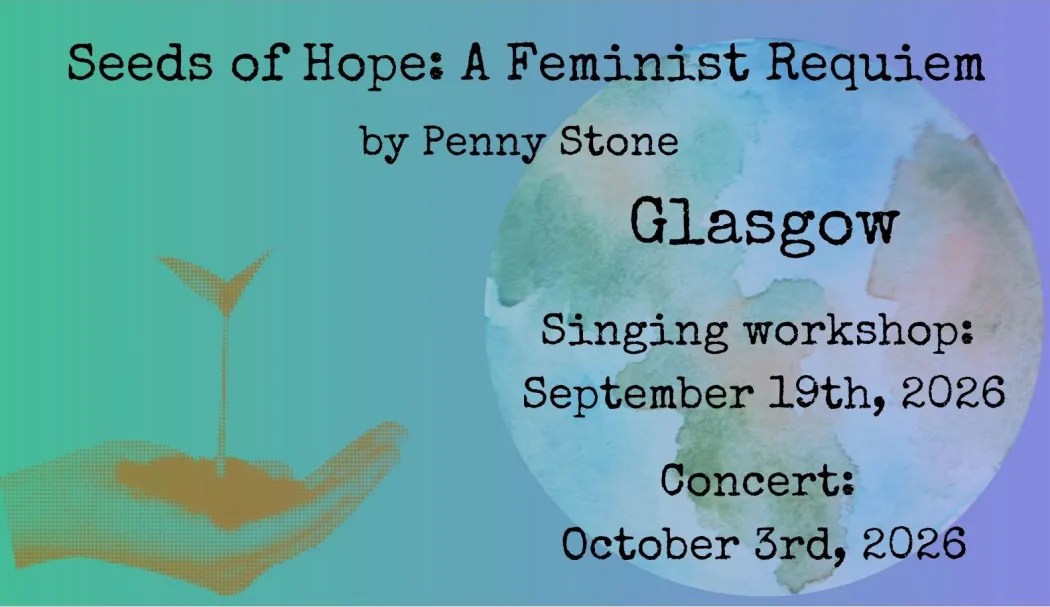
Few people get far through life without carrying a death or two. It’s helpful to share the load, and one way to do so is through music written to express the composer’s grief. There are many beautiful, devastating pieces of music, in all traditions and styles, that can help us to understand our own bereavement in relation to others’. For the most part, when we do this through music, it’s as passive listeners, as receivers of an act of formal communication that allows us to find parallels with our own experience. Penny Stone, in Seeds of hope, has developed an evolving project with a much more participatory approach. Written originally as a requiem for her mother, it is conceived to be as inclusive as possible, using texts in 18 languages dating back as far as 575 CE, and performed by a combination of professional musicians and a community choir, with (entirely optional) opportunities for audience participation.
The music is simple and modular, without any exacting harmonies or forbidding complexities, designed to accommodate all voices, and to easily bear the weight of non-professionals’ divergence from the musical text. The whole thing is taught by ear, each section as memorable as it is straightforward. Music snobs may be dubious as to the expressive capacity of an approach like this, and I’m the first to agree that the rigorous intricacies of many pieces of music have real value, expressing precise subtleties of meaning and feeling that can’t survive paraphrase or simplification. But they are also limited in the meanings they convey to those able to live in that one way professional discourse of active performer and passive audience. There are many more things to think and feel, and a lot of them can only be felt and thunk together.
Seeds of hope also resists the formal separation of composer from composition. Penny Stone was there in the Glasgow University Chapel explaining the what and the why of the piece, and her easy, empowering manner as a teacher made it straightforward for the audience to participate (or not, if that was what they wanted). She directed and enabled the performance, and there is no way on earth that it could be reproduced in a meaningful way if you simply gave a score to a conductor and told them to get on with it. She performed (and she is clearly very accomplished as a singer and a conductor), but she performed with rather than to.
The result of this was, on the one hand, beautiful music and poetry, that seemed to belong to everyone present for the time that it existed in the chapel; and on the other hand an extraordinary opportunity to grieve in company, to grieve as a group, without anyone needing to know the particulars of anyone else’s loss. Mourning can be a very lonely activity, a reductively solitary one, where every individual that knew a dead person grieves separately for the facets of them that they alone knew. There we mourned together – I brought to mind as many of the people I’ve lost as I could, from close relatives to casual acquaintances – we collaborated in grieving, whether or not we got up to light a candle at the mid-point, and whether or not we wept, as many audience members did. The music, in the abstract, was beautiful, but what it sounds like in the abstract is entirely beside the point. Penny Stone’s composition takes shared experience as its basic material, human hearts as its instrumental forces, and instead of an aesthetic text, its product is a community of remembrance. For me that’s as great a creative and technical achievement as any formal or harmonic innovation she might have presented.


Leave a comment