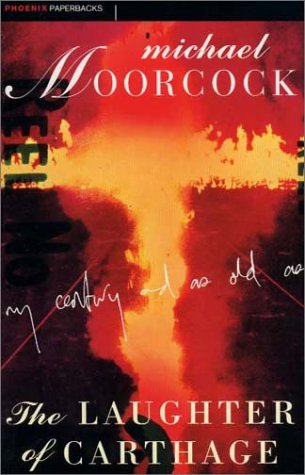
Maxim Pyatnitski or Colonel Pyat or Max Peterson or etc. The narrator of The Laughter of Carthage, the second novel in Michael Moorcock’s Pyat quartet, goes by these names and more. He is variously a scientist, an engineer, a public speaker, a Ku Klux Klan affiliate, an actor, an impresario, an aviator, a screenwriter, a businessman, or an intelligence agent, depending on who he’s talking to. He’s a philanderer in his personal life, and a financial chancer. It’s not quite accurate to call him a con-man, however, as one of the many ironies from which this book is constructed is that he’s constantly the dupe in other people’s schemes, and that he continues to trust those that deceive him, while projecting his suspicions and paranoia onto imaginary figures. He’s a narcissist with strong views on what narcissists are like, and a bigot with a strong sense of his own tolerant nature.
It would be very hard to like Pyat, and that’s the key irony here – the narrative irony, so to speak. He’s constantly getting into scrapes, and struggling to extricate himself from situations of his own making, all of which is narrated skilfully and suspensefully. His monologue is convincing and coherent, inviting, as all first-person narration does, the identification of the reader – the recognition of an inner life comparable to the only one you’ve known. As you let the text’s rhetoric carry you along, you naturally want to see situations resolved, tensions released and goals achieved. And then you are forced to take a step back, and ask yourself where your sympathies lie. Multiple opportunities to do so are provided, but there’s no judgement in the authorial voice, no sense of a moral hierarchy – Pyat is given all the rope he needs. He’s an active paedophile, and he’s present at a lynching, which he celebrates, but these extremes are really present to query the reader’s morality. If you haven’t noticed where his thinking leads before the narrative slaps you round the face with his depravities, you haven’t been paying attention.
Another important irony is the tension between the notion of this first person account, and the rhetoric of the novel. Moorcock’s metatextual introduction would have us believe the text is assembled and edited from autobiographical notes Pyat bequeathed him on his death. This is given the lie by the meticulous construction of the book – it’s an episodic picaresque, but narrative threads and tension and release are managed carefully throughout, with no further intrusions from the fictional Moorcock’s editorial voice. Instead we’re asked to question the truthfulness of any account that appears to be truthful, singular and reliable. After all, there’s a first-person implicit in any statement. Stories like these, entertaining fictions, are the kinds of thing we tell ourselves, in order to make our lives comprehensible, and to justify our behaviours.
Moorcock was probably setting out to ask how those internal processes would look from the perspective of someone who supported the great political evils of the twentieth century. That’s certainly the most interesting thing about this text, in my opinion. It offers an incredibly, revoltingly plausible picture of the kind of narrative that led from the disintegration of Imperial Russia’s defective social contract to the death camps of Nazi Germany. It’s a self-deluding, self-aggrandising refusal of responsibility – a moral infant’s attempt to scapegoat his way out of the damage caused by his entitlement and self-regard. It’s a fair question to have asked in the 1980s, when the post-war settlement was being picked apart by monetarism and the globalisation of finance, and it’s an incredibly important one to be asking today, when the consequences of Thatcherism and Reaganism (the power always likes to hide behind a figurehead) are coming home to roost.
This is far from a simple, on-the-nose polemic however. It’s a beautifully written novel, and Moorcock puts some perceptive insights in Pyat’s mouth along the way. He lives in many of the world’s most important cities – Constantinople, Paris, New York, Los Angeles – during the early 1920s, a time when many of the certainties of twentieth-century history were still up for grabs. There’s a great deal of research behind Pyat’s descriptions of these places, and a compelling evocation of time and place – one which it’s hard to credit to our delusional and often slow-witted narrator. That’s kind of the point. The more plausible he sounds, the more the text encourages its readers to recognise themselves in Pyat, the more powerfully it compels us to query our own moral perspectives. Not by judging or arguing, but by putting balls in the air and letting us decide where we think they should fall. For me, that’s the greatest gift a novel can give.


Leave a Reply