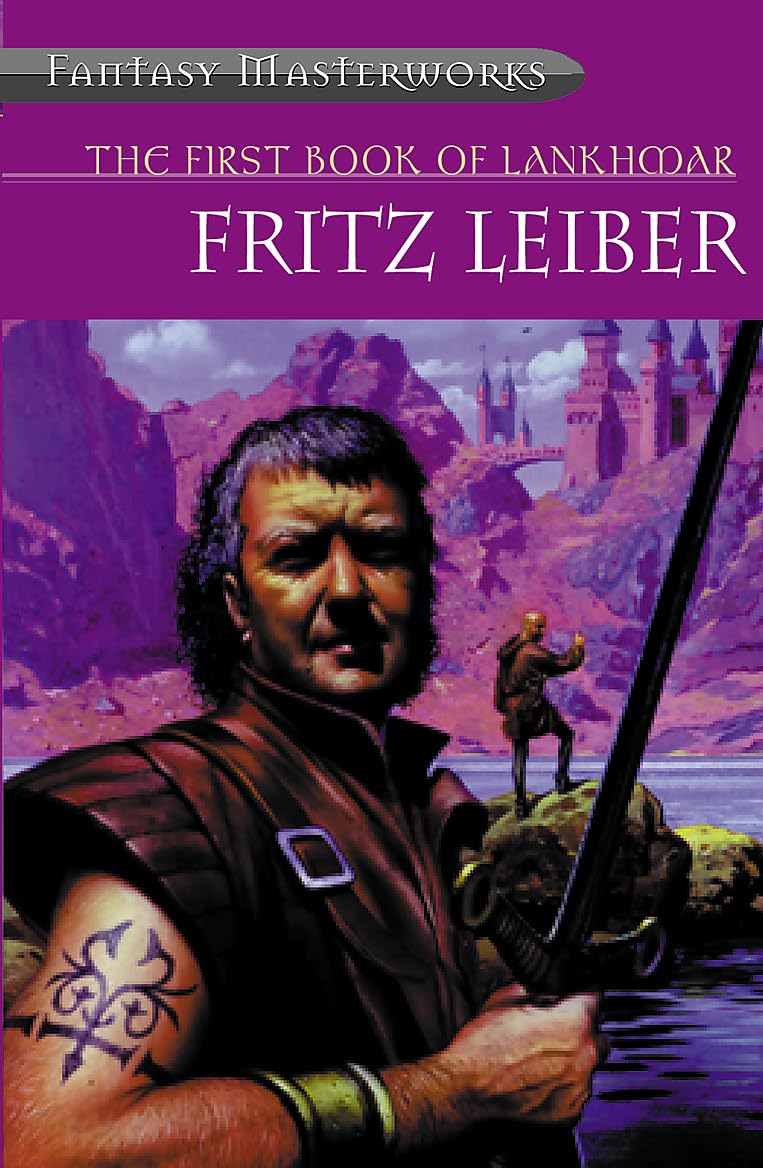
Fritz Leiber is one of those names that formed the background to fantasy when I first became aware of the genre. He’s a major figure in the strand of writing that didn’t start by cashing in on Tolkien, and an inheritor of the tradition that leads from Edgar Rice Burroughs, through Robert E. Howard and on to Michael Moorcock. In fact, it was Leiber who came up with the term ‘sword-and-sorcery’, in response to Moorcock’s prompt in the pages of a fanzine – this is the kind of fantasy in which morally grey, self-serving characters get into scrapes and prevail through cunning, courage and martial skill. His Lankhmar stories feature the duo of Fafhrd, a gigantic quasi-Norse barbarian warrior, and ‘the Grey Mouser’, a diminutive, agile rogue and occasional magician. These self-starting stereotypes are immediately subverted by Fafhrd’s intelligence and erudition, balancing his companion’s impetuosity.
The First book of Lankhmar collects four short novels from around 1970, the pocketable length that SFF books tended to be before the inflationary pressures of epic fantasy and the planetary romance produced today’s ballooning page counts. Each novel is really a collection of short stories or connected episodes, however, without the narrative through-lines that are demanded in the modern genre. They’re punchy, exciting, humorous and entertaining, without much to say about the larger world, or good and evil, or found family, or any of the worthy concerns later writers tend to include. Moorcock was influenced by Lieber, and said many kind things about him, but even his early, punkish, quickly written sword-and-sorcery tended to further some kind of philosophical or political agenda. Lieber didn’t think too hard about any of that – he just took the world as it was given to him, and invented a fantastical, escapist version of it.
The most obvious shortcoming of that approach is that in common with many of the founders of his genre (there’s hardly a woman in the whole of Robert E. Howard’s Conan the Barbarian sequence that doesn’t have the adjective ‘supple’ attached to her), he uncritically reproduces the retrogressive social politics of his era. ‘He was a man of his times,’ you might say, or ‘you can’t judge historical culture by today’s standards’, but the fact is I can’t imagine reading this stuff as a woman without feeling pretty pissed off. ‘Girls are for dessert’ apparently, and people with black skin are exotic, and ‘Mingols’ are squat, swarthy easterners, cunning but unscrupulous. So sure, he was a man of his times, but unless you are a cis-hetero white male you’re likely to find yourself cast as ‘other’ in these stories, somewhere along the line. Consequently, although the stories are skilfully written, the fun is not evenly distributed.
The writing style is arch and humorous, but not baroque – it’s something like a toned-down version of Jack Vance or James Branch Cabell. Leiber shares those writers’ taste for irony, but not their insatiable appetite for obscure vocabulary. He certainly has a style, however, in a way that seems to have become unfashionable in commercial fiction. There’s a lot of received wisdom about using adverbs (to the effect that you shouldn’t), but Leiber loves ‘em – to the extent that he gleefully invents them on the fly. An edged weapon might be ‘stabbingly curved’, for example. Does this make his prose indigestible or slow the reader’s progress? It does not. It just makes it more interesting and enjoyable to read. Despite the continual irritant of Leiber’s unexamined politics, his personality was endearingly present in each sentence he wrote. I struggled a bit with the length of this collection, as it comes in at nearly eight-hundred pages, and when a writer has nothing in particular to say, it tends to pall for me pretty quickly; but I don’t suppose for a moment that Leiber wanted anyone to read this much of his work at a sitting, and in the small doses his original publication schedule prescribed, there’s a lot of entertainment value in his stories.


Leave a Reply