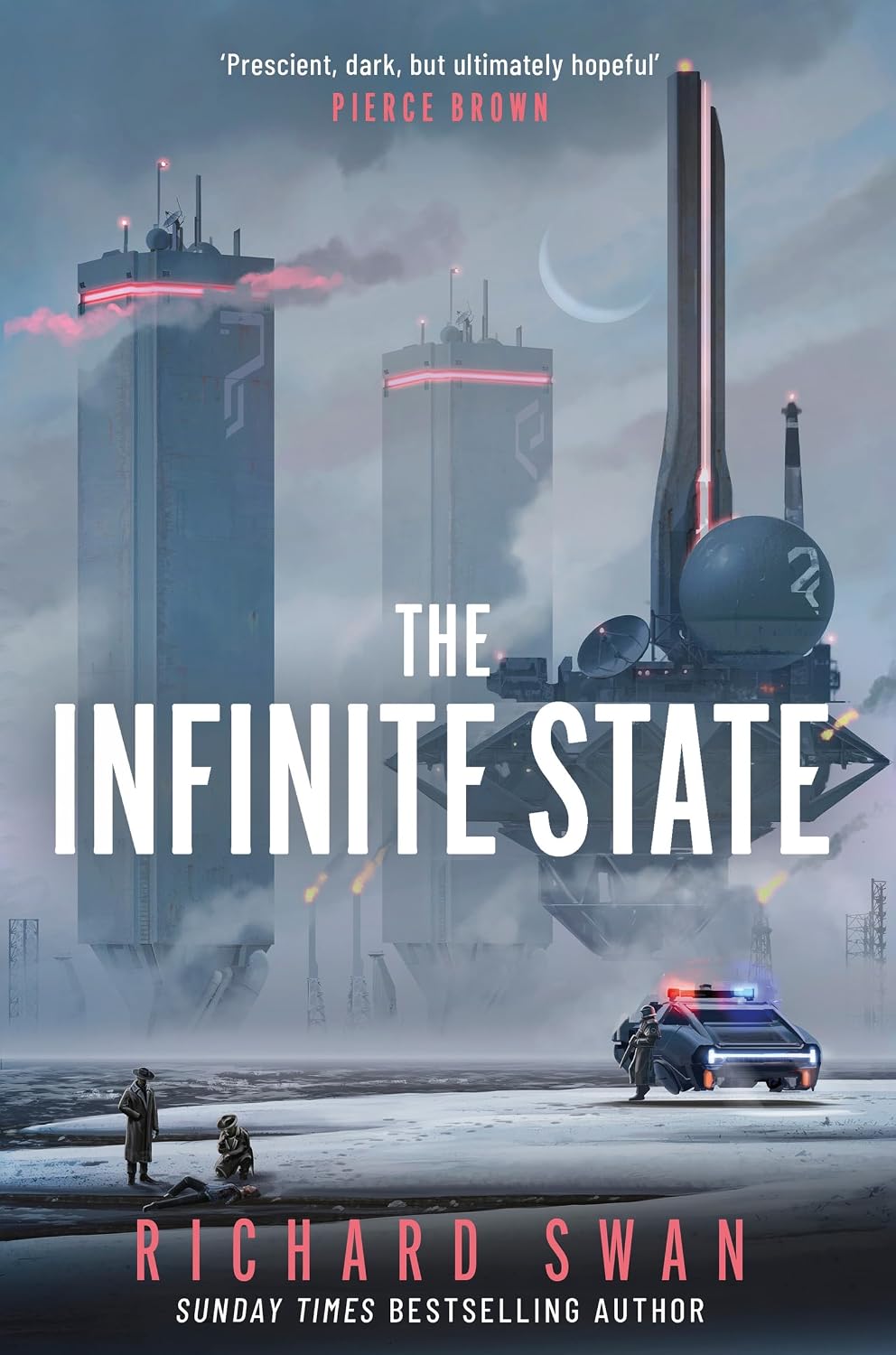
The Infinite state by Richard Swan opens strongly. It’s very thriller-flavoured from the off, but rather than dropping us into police procedural or the exciting life of a racing driver, we start with a woman trying to have a child with the assistance of some futuristic medical technology. From there we get the other things I mentioned, and a lot of political intrigue, in a clearly-imagined totalitarian state. The book is space-opera, with very little dwelling on the practicalities of how its advanced technologies might actually work, but a solid speculative focus on how authoritarian governments could operate in such a future. To be clear, there are plenty of contemporary examples, like China and Russia, and he doesn’t stray too far from the playbook they provide, but he does a great job on the political cut-and-thrust and the socio-cultural experience of living under such a regime. He furnishes his junta with the colours and stylings of a kind of pan-European Fascism, which will perhaps make it easier to imagine, and easier to fear for many English-speaking readers. The overwhelming power, the inherent fragility (promoting increased brutality) of such a polity is realised with plausible conviction. It’s no 1984, and enough hope needs to exist for the reader to be carried along on a conventional thriller plot, but it is a very dark place, and few good outcomes suggest themselves as the story unfolds.
Which makes the deus ex machina enabling the second act rather disappointing, for me. It felt as though Swan realised the trajectory his story was on and bottled out. He was beginning to imagine how alternatives might arise to a totalising dictatorship, how forces within it might begin to pursue more altruistic politics, but retreats with almost visible alarm from confronting the political thinking (and undesirable individual outcomes) required to plausibly develop such a scenario. Instead he decides to have a battle, because that’s always exciting, right? At the same time he struggles to convincingly evoke the cultural implications of a successful fascist regime: characters abandon patriarchal thinking and coercive politics far too readily for me to believe they had really been formed in such a state. The second act of the book is also a lot shorter than the first, which makes it seem more of a hurried escape from a difficult creative bind than a considered conclusion even to the thriller we’ve been reading, let alone the political novel. For me the book needed to be longer, darker, and more serious, not because I think books should be like that, but just because that’s how it was set up in the opening act.
The writing is technically excellent (notwithstanding some patchy editing in the later stages), in that kind of style-free way commercial fiction has in whatever nowadays you happen to inhabit. Of course no prose writing is without a style, but Swan’s might be termed a ‘historical style’. It will eventually become dated, and then come to be characteristic of early twenty-first century fiction; but at the time it’s hard to put your finger on what stylistic choices he’s making – largely because a lot of other writers are making identical choices. There’s nothing wrong with that, but those frictionless rhetorics are tied up with a very linear, instrumental approach to storytelling that may not be the most conducive to considering questions like those Swan puts in play. The kind of ‘zoefuturism’ proposed in some academic writing recently suggests politically engaged SF may need an alternative to ‘one or a group of heroic individuals punch through obstacles to attain their clearly defined goals’. There’s no reason any individual writer needs to adopt such a method, but the grim circles in which this story initially moves seem to me to be fatally undercut by the thrilling solutionism of its denouement. It was a fun read, and I raced through the closing chapters, but at the outset it had promised to be whole lot more.


Leave a Reply