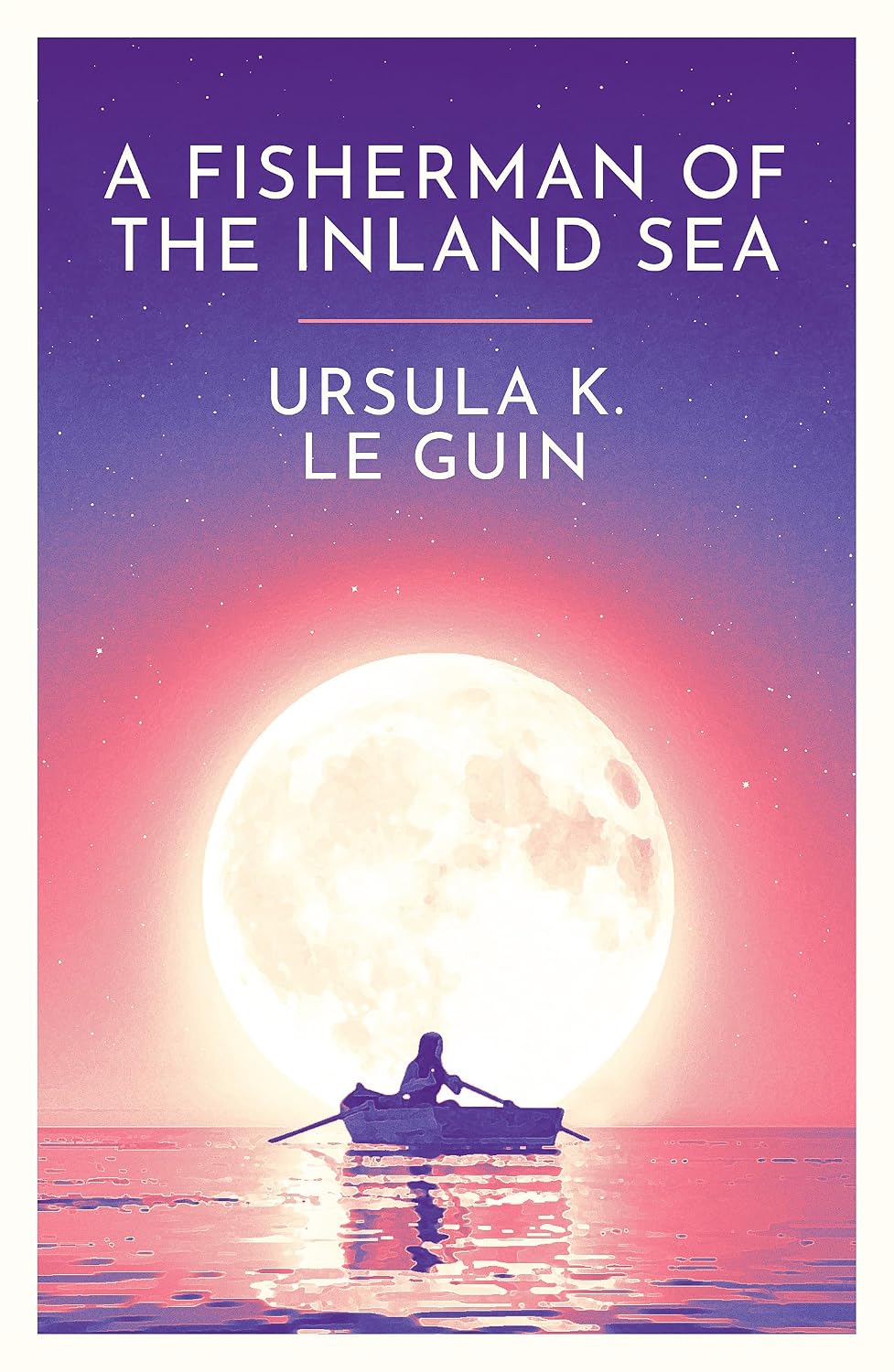
I feel as though Ursula K. Le Guin’s work isn’t very well-known, despite her fame. What’s known is the Earthsea fantasy series, and her 60s and 70s SF (later Earthsea stories also got plenty of exposure, thanks to omnibus editions etc). I’ve been on a mission to read through the fiction she published subsequently, and I’ve found some truly beautiful writing, much of which seems to be out of print, especially if it isn’t genre fiction. The collection A fisherman of the inland sea, first published in 1994, is available in a handsome Gollancz paperback, probably because it sits more comfortably within most readers’ expectations of Le Guin. These are all SF or speculative stories, including a sequence of three that explore the idea of faster-than-light travel in Le Guin’s famous Hainish universe. Two are fantasies-without-magic, stories set in imagined pre-industrial cultures, and two are comical quickies.
They’re all fun, thought-provoking, moving, or some combination thereof. The Hainish stories are certainly all three – they scratch the itch many readers will feel for a return to that most intriguing of space opera settings, while exploring some interesting ideas around the relationship between narrative practice and the experience of time passing. Being the kind of writer she is, these ideas are investigated both in a philosophical way, and by digging deep into what it might feel like to live with some of their speculative implications. The final story, the title piece of the collection, is as affecting a tale as any I’ve read by Le Guin. In ‘Another story, or a fisherman of the inland sea’ she puts into action the manifesto she sets out in her introduction – to write stories about people, and to use the trappings of SF to do so in ways that would be otherwise unavailable. The way that lifetimes pass, printing onto our relationships and experiences the decisions that we make quite blithely in our youth, becomes the subject of a story about mutable temporality in a technology for instantaneous travel.
In earlier stories she used the dilatory effects of travel at relativistic speeds to explore the same themes in different ways. It felt good to see her writing progressively and pushing at boundaries, a good thirty years after she first made waves in SF communities. Her technique is always precise, and aesthetically tuned, but rarely formally radical. She’s just an incredibly accomplished prose stylist. She does use what might be termed ‘experimental’ tactics to represent the breakdown of sequential experience in ‘The Shobies’ story’, but it’s as precisely representational as her writing always is. It seems like her, in that her development is visible but incremental – she always took it slow, and waited until the right words came. Her genius in all of her writing, and very much in this collection, was in knowing precisely when they had arrived.


Leave a Reply