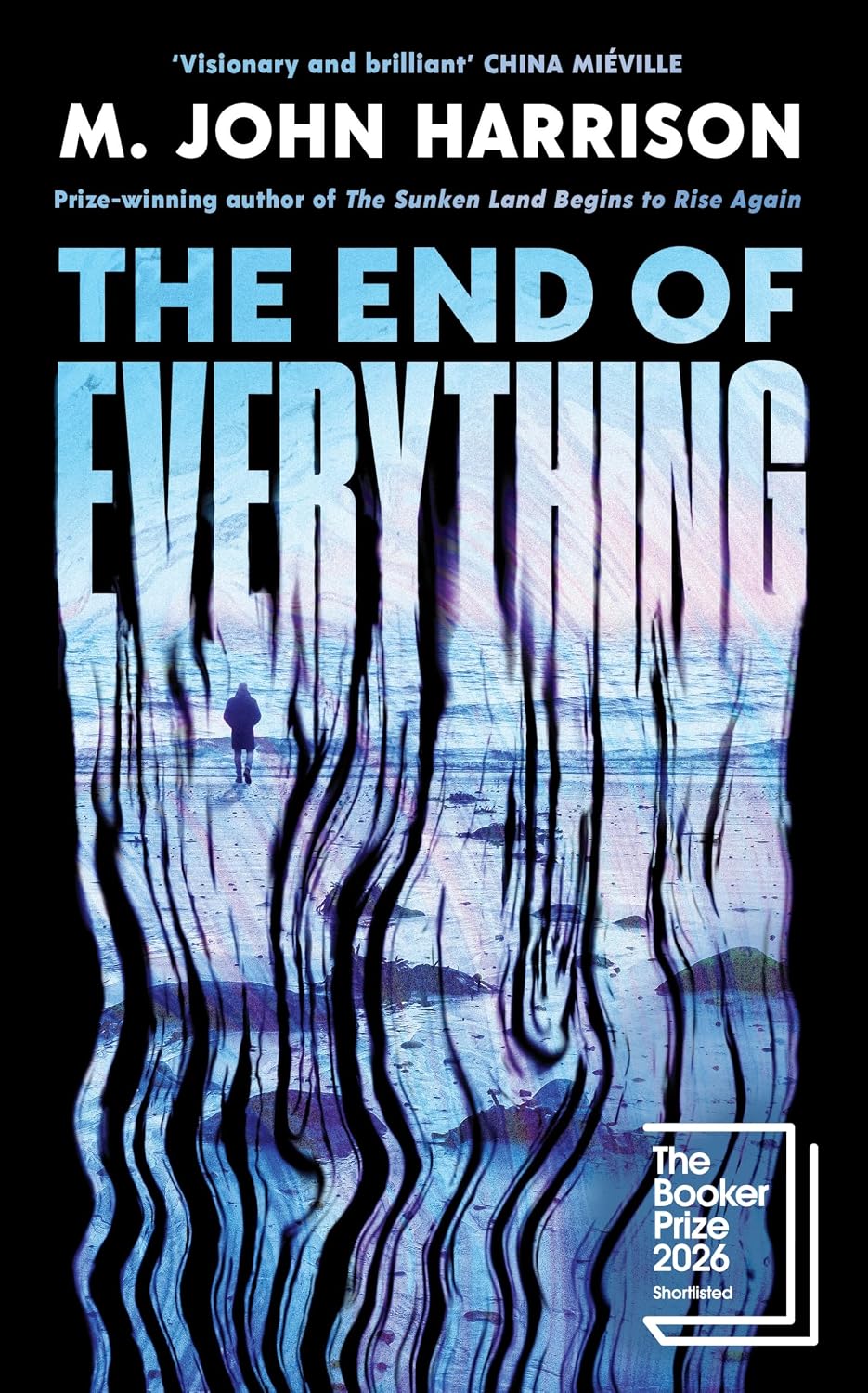
A strange world in which an ill-defined crisis or catastrophe is unfolding, while people go about their banal business as usual. A strange figure, pulled from the sea, which seems to act as a kind of polymorphous simulacrum. A breakdown in causality, or in the appearance of causality. A fragmentation of experience, and a seeming disassociation between the parts of psyches, the parts of society, the inner lives of characters and the events they inhabit. A narrative in which pieces of language seem to collide, fugitives from disparate texts, interiorities bashing up against reportage, art-historical or philosophical musings against descriptions of violence.
I’m describing aspects of the world evoked in M. John Harrison’s masterful novel The End of everything. But I might equally be describing the world of a Michael Moorcock character, which first appeared in print sixty years previously. Although he admits it took on some life as a fictional person, Moorcock is clear that his ‘English assassin’ Jerry Cornelius is more a literary technique than a narrative subject. In 1971 he published the group Cornelius anthology, The Nature of the catastrophe, to which Harrison contributed two stories, and it’s hard to take it as wholly coincidental when one of the protagonists in his latest novel opines that ‘the nature of the catastrophe is that it has no nature’. Moorcock claims to deploy the technique best suited to the topic at hand, which led him to turn towards Realist methods in the 1980s. Reading The End of everything, although it is certainly not a Jerry Cornelius pastiche, I got the impression Harrison may still be investigating the possibilities of the Cornelius methodology.
There are other breadcrumbs as well, nods toward Moorcock’s multiversal cosmology. It’s very easy for an enthusiast to go running off after hints like those, looking for the key to unlock a book, the cypher that will reveal its correct interpretation. But while lesser writers might publish with a singular reading in mind, I don’t suppose for a moment that Harrison is offering his readers a puzzle, or asking them to decode his novel. Instead he’s representing a complexity, one or several of the many complexities we live with, and for me it feels like an explanation of the book would be hopelessly reductive.
The action takes place in an England isolated from the outside world by factors connected to an ongoing war against a group of gnomic alien invaders called the iGhetti. Munitions are poured into the City of London, while those living just outside it are free to continue with their everyday lives. The Kent coast is littered with shantytowns of beachcombers, pulling mysterious iGhetti artifacts from the water. The apparatus of government and policing seems to have vanished, leaving people to deal with disorder in sometimes shockingly violent ways, yet the seaside towns are still crowded with middle-class holidaymakers and their SUVs. This is clearly some kind of allegory: a society that’s losing its moorings and its infrastructures while its people carry on as though everything were fine is, after all, very like the one we live in. But it is complex, and Harrison re-inscribes its complexity rather than simplifying it. His characters are both mimetic and symbolic, stumbling through a changed world in the manner of changed people.
I could talk about it all day, but you’d be none the wiser (and nor would I). The End of everything is a short novel of razor-sharp sentences, stirring some unexpectedly specific observations and insights into its mélange of the familiar and the inexplicable. It comes with just enough in the way of genre tropes that we might call it dystopian science-fiction, but it leans heavily into the uncanny, and that’s its primary gift, for me. It looks at the ordinary from weird angles, in weird lighting, and offers a different understanding of the prosaic. It’s a poem – a piece of writing intended more to present an arrangement of thoughts for the reader’s contemplation than to narrate a series of events – but it uses the sequentiality of the novel to articulate its ideas, in thought-provoking, disturbing, and strangely beautiful ways.


Leave a Reply