James Branch Cabell is largely forgotten today, even among avid readers of fantasy fiction. He and his work belong to another age, but there is much to admire and enjoy in it. He was a Virginian gentleman, who lived a life of ease, and wrote with the kind of sprezzatura essential to gentlemanly conduct in Renaissance Italy. Everything is done with effortless grace, and if you are good at something, it is utterly essential that you conceal all the effort involved in learning it and doing it. Everything must be done archly, easily, as though it ain’t no thing. One is never committed, never emotional, always amused. Cabell was a belletrist as much as he was a novelist, a crafter of finely turned sentences, each delivered with the insouciance of a fin-de-siècle playboy discarding the foil from a champagne bottle. He wrote to escape, and so that others might escape, from the tedious mundanity of the everyday.
Most of Cabell’s books were set in and around the fictional French province of Poictesme, in a world populated with knights, dragons, wizards, damsels, and all the usual trappings of the quasi-medieval romance that became popular in the nineteenth century. His representation of this world is satirical and mocking, however. His heroes are not chivalrous, but violent, libidinous and self-serving. His women have sexual appetites to match his men, and frequently more intelligence (although few readers would mistake him for a feminist). The stories are told with ironic detachment, and with a deliberately abstruse vocabulary that was clearly a big influence on Jack Vance, through whom many tropes reached role-playing games and thence the canon of fantasy cliché that we draw on today. If a writer chooses to overturn a stereotype in fantasy fiction, it’s likely to be one that Cabell was already lampooning a century ago.
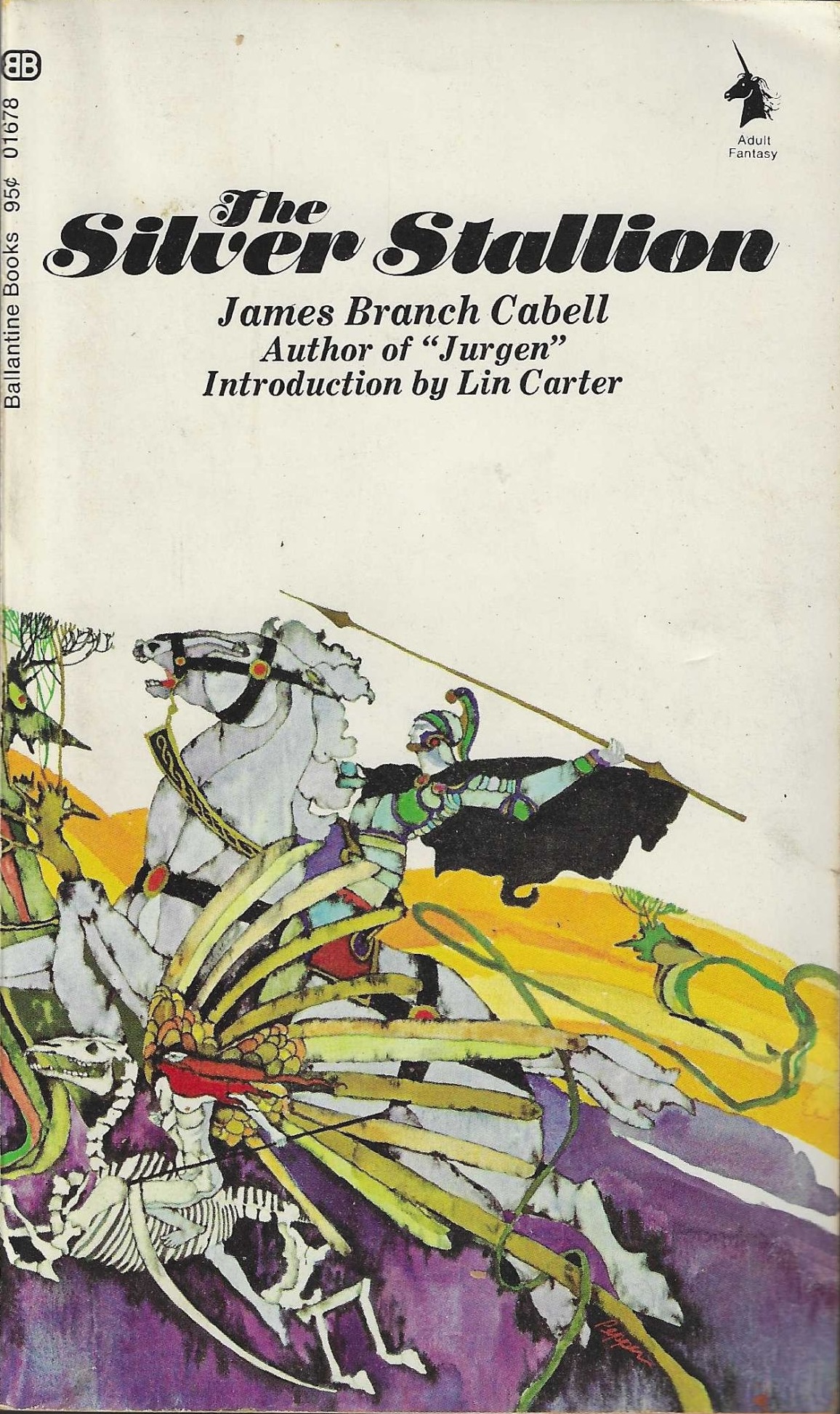
In The Silver stallion we accompany the doughty companions of Dom Manuel, the chancer who became the Count of Poictesme, and whose biography (extending to that of his descendants) is the subject of literally dozens of Cabell’s books. We join the story after Manuel’s disappearance, and discover how his erstwhile henchmen deal with life while his widow establishes his cult as a virtuous redeemer, prophesied to return at some indeterminate point and restore Poictesme to its fabled greatness. Needlessly to say, this new, virtuous version of their lord and country is not universally to their liking, and much comedic mileage is made out of their nostalgia for a youth filled with plunder, violence and sexual misadventures. Of course Cabell is satirising not only the supposedly virtuous protagonists of such stories, but the entire genre of the nineteenth century medieval romance, as popularised by Alfred Tennyson, Walter Scott, William Morris and others. It’s a refrain I find it refreshing to hear sung in fantasy’s relatively early history, as I’ve always found it tiresome to read books that present knights in armour as the good guys. They never were. They were violent, brutal thugs and armed robbers.
If you’re in any doubt as to whether such people were still valourised in Cabell’s time, just watch a 1930s Western. Cabell shows us that not everyone went along with it. At the time his books were considered extremely risqué, filled as they were with double entendre, and racy illustrations. Jurgen was famously prosecuted for obscenity, but the judge apparently thought that anyone likely to be corrupted would be insufficiently educated to decode Cabell’s prolix and erudite prose. For me, the prose is no barrier, but an entertainment in its own right. I read the 1969 Ballantine reprint, which preserves Frank C. Papés original 1926 illustrations. Papé was a British illustrator, who like Cabell is little remembered in fantasy circles today. Like many artists and writers of the time, his approach to representing women and non-white people isn’t great, but his work is very decorative, and is perfectly matched to Cabell’s prose. The Silver stallion is an elegantly written, intelligent, and still very funny book.


Leave a Reply