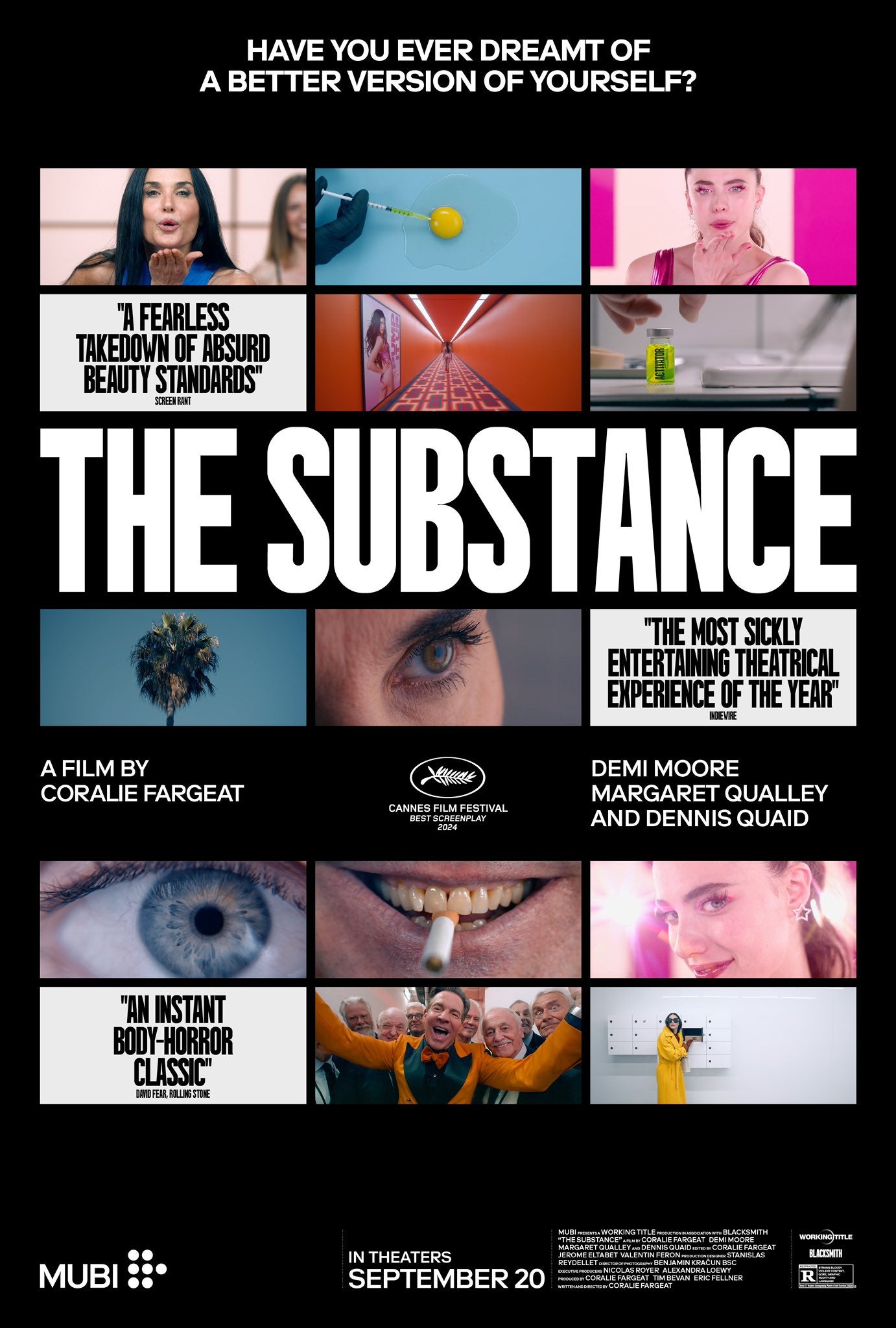
The Substance opens poetically, with exquisite cinematography. It puts simple, enigmatic images before the viewer with the most delicate precision. Benjamin Kračun shot the film digitally, for the kind of hyper-real perfection its topics require, but used some vintage lenses, and paid very close attention to colour and tonal qualities. These are equally important in the later scenes, saturated as they are with incident and affect, but at the outset things are very calm, and it was the beauty of the camera work that drew me in. Of course, it’s hardly surprising that care was taken over the individual image in this film’s production.
There are two women in every woman. This observation applies to humans of any gender or none, but particularly to women, in the culture we happen to inhabit. There’s the body, the self; and then there’s the image. One is not a person without the other. This is true equally of those women who decline to take pains over their appearance, or who deliberately resist received assumptions around the ways that women are meant to appear. That corporate being variously called society, culture, the status quo, the zeitgeist, the media, the nation, the discourse… makes reductive images of human beings and reflects them back at anyone who happens to be looking. These representations become the sole valid currency in many or most of our social interactions. This splitting is as true of the most photogenic, gender conforming women as it is of everyone else. The body that (like all bodies) sweats, farts, has hair in the wrong places, occasionally smells weird, and experiences everything, is radically absent from the image.
This dichotomy or duality has been extensively queried in art in all media, but the examples that spring to mind most readily tend toward the typologies of elite culture, like the art-photography of Cindy Sherman. By and large (and doubtless with many exceptions that will occur or be pointed out to me as soon as I publish this), the genres and sub-genres proper to mass culture have been untroubled by serious feminist interventions. The gleeful carnage and gut-wrenching imagery of body horror certainly hasn’t been the foremost avenue for artistic examinations of these important topics. Enter French director Coralie Fargeat, with her second feature film.
Once the action begins in The Substance, it’s clear that we’re in some sort of fantasy. The styling situates us firmly in the 1980s, but it’s not long before we see the characters using smartphones and USB pens. That era was a good choice – it was perhaps the first decade to believe wholeheartedly in the supremacy of the image. With its reductively smooth surfaces and big, bold blocks of colour, 1980s design thought it had entered completely into the postmodern. Its practitioners couldn’t even begin to imagine what was coming for them. That visual naïveté allows Fargeat to trade in big, bold symbols, appropriate to an examination of the image, and those smooth surfaces constitute a perfect theatre for the extreme surface transgressions that are to follow. Similarly, characters are provided with behaviours rather than interiorities. The doubling described above is made literal in the narrative, and the various symbols that Fargeat (also the screenwriter) puts into play are skilfully marshalled to explore, satirise and critique the ironies by which the image is held in tension with the corporeal. Grotesqueries are accumulated so gradually that the viewer becomes almost accustomed to them, only for Fargeat to poke a hole in whatever limit we may have imagined to pertain. Eventually there is so much blood flowing that the film becomes, as so many horror movies do, extremely funny.
This only works because the actors play their parts with exacting conviction. Many body parts are in the wrong places by the end, but tongues are never in cheeks. Demi Moore, as an aging fitness celebrity, is so intensely serious throughout that when we are forced to confront her fear and insecurity it feels like a rusty knife. Margaret Qualley’s role is the embodiment of youth, and of the hypersexual version of femininity hawked by the image industry: the impermeable barrier of her performative vulnerability is equally precise. Neither actor was required to represent a whole person, and neither makes the mistake of trying to do so. In the end, even the densest viewer should be clear that the horrors they’ve witnessed on screen are trivial next to those visited on women by the theft and commodification of their own images. I’m not a connoisseur of body horror (I’ve enjoyed a few David Cronenberg movies) but I thought this was brilliant.


Leave a Reply