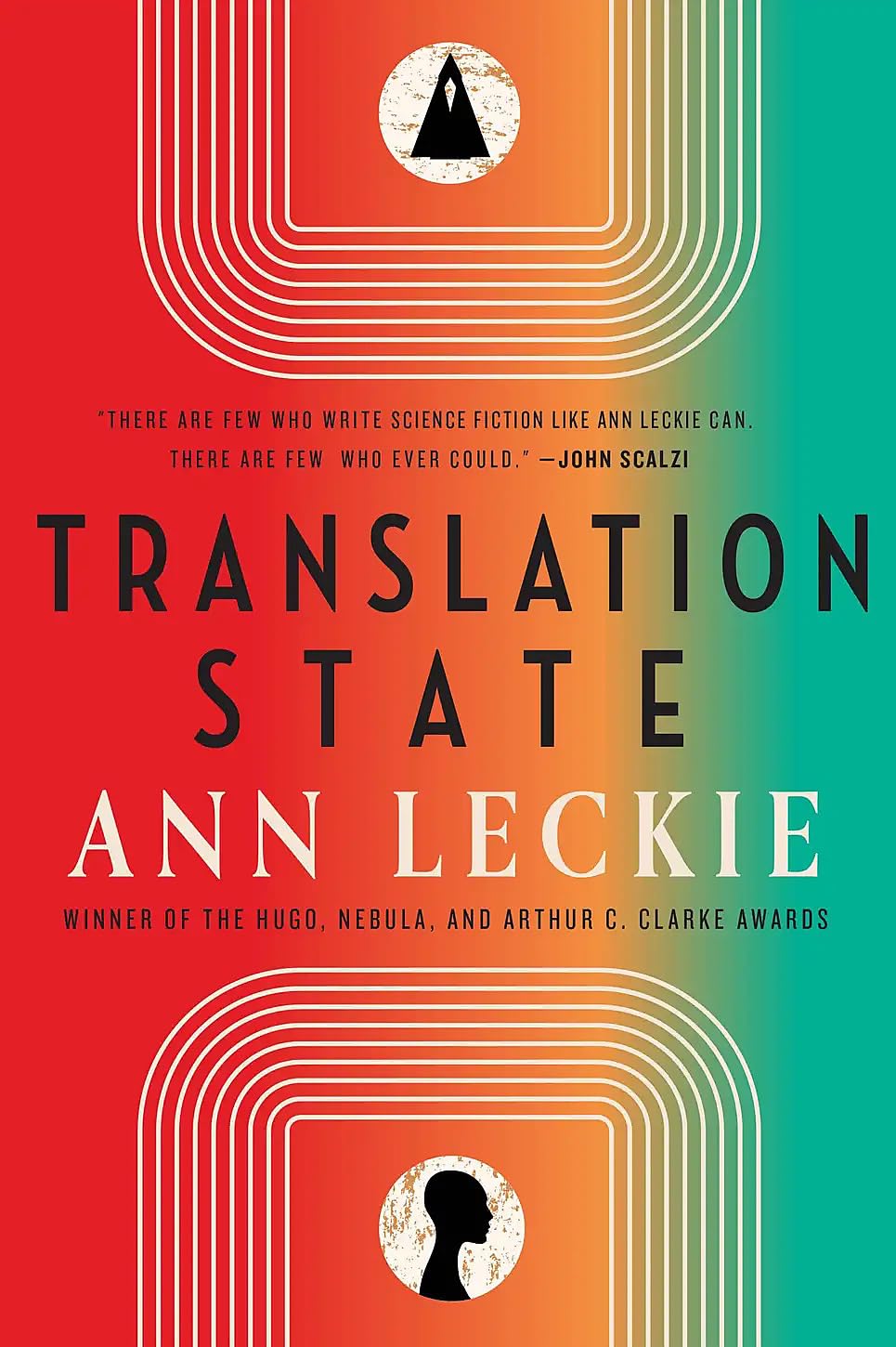
Translation state drops the reader into a number of lives we might find familiar, or at least recognisable. A junior member of a wealthy family, bereft of the matriarch who has belittled them for most of their life. An adopted maintenance technician, finding their ethnicity of birth among a community of exiles. A child growing up among, and sometimes eating or vivisecting other children. Well, okay, maybe the last example is less familiar, but that character turns out to be as vulnerable and as empathic as the others, if a little less human. These lives gradually converge on a high-stakes crisis where their conflicts and obstacles are resolved, and they find the chance to choose their own directions, rather than blowing in the winds of astro-political power. So far so thriller plot. It’s a good, tense fabula, well paced and executed, but it’s other elements of the book that elevate it out of the ordinary.
I’m new to Ann Leckie’s work, but she’s written a number of space operas in a shared setting, and this one has some history to draw on. It doesn’t require any familiarity with her other books, but you can kind of tell that there’s a bunch of stuff in the background – it’s not impossible to create the impression of depth a priori but I feel like it’s a lot easier to be convincing if you’ve accumulated some complexity already. There are a lot of small gestures to bigger pictures here, and it makes Leckie’s world(s) come alive. This is an interstellar society with just the right mix of overlapping ethnicities and power centres to feel something like the chaotic happenstance of primary world geopolitics. Her characters also feel like they emerged from these settings, without feeling so distant from us that we can’t imagine what it would be like to be them. When something is actually alien, it feels very alien indeed, but when it belongs to a human culture it feels particular.
These elements of the alien and the culturally specific interact in complex ways to propel the narrative, and to provide the characters with motivations. One of the conceits here, of aliens whose personhood is distributed across more than one body, put me in mind (because they are engineered to be translators) of the translators in China Miéville’s Embassytown, but for the most part where Leckie departs from widely shared space opera tropes (space stations, intelligent starships etc) it seems very original. Ideas of the disseminated self, and related concepts around personal transition, are used cleverly and empathically to explore the socially situated experience of being. Leckie traverses this territory in insightful ways, which struck me as provocative and illuminating. What are the edge conditions for personhood? Is its ending synonymous with death? What transitions can cross its boundaries, and how do they do so? Where does one person end and another begin, spatially or temporally?
Leckie is far too smart to answer any of these questions, but what she is very good at is embedding them in personal narratives her readers might care about. None of the characters in this story are heroic. They’re all quite ordinary in terms of their home cultures, and two of the three protagonists are ordinary in ways that we ordinary twenty-first century citizens can recognise. If anyone is stuck with any inherited ‘specialness’ then it is quite properly shown to be a burden. By the denouement I was fully invested in the characters, and I wanted them to find answers to the questions in the paragraph above, answers that would bring them happiness and peace of mind. No spoilers, but Leckie’s are a safe pair of hands. I found Translation state a very entertaining, moving, and perceptive book.


Leave a Reply