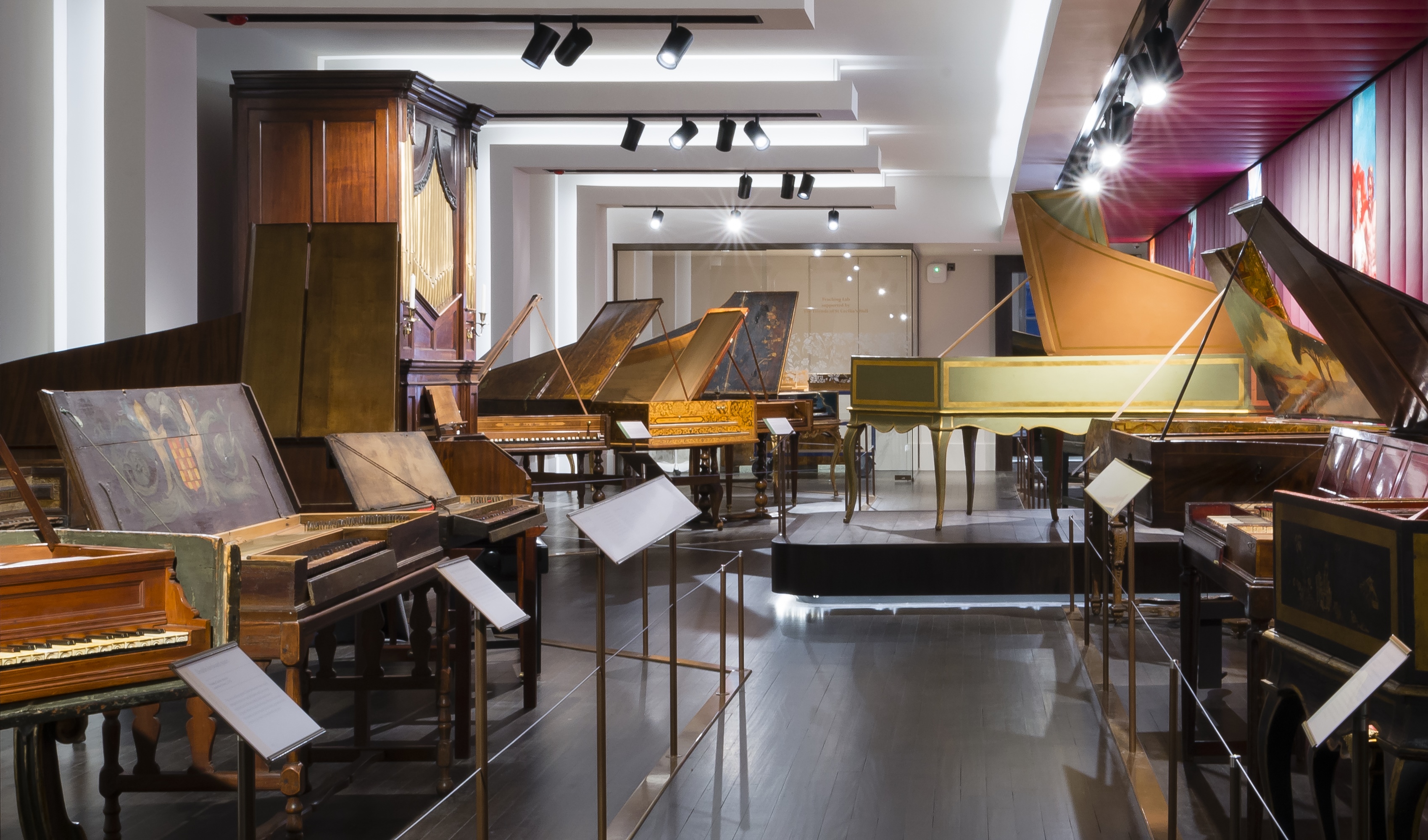
I have a bugbear, in relation to museums that collect musical instruments. They are often treated as pieces of furniture or objets d’art, conserved to preserve their appearance and physical integrity, without conserving their sound production capacities. In my opinion, this misses the point entirely. You wouldn’t conserve a painting simply to arrest its deterioration, but make it impossible to see. Obviously some musical instruments are too fragile ever to be restored to playable condition, and it’s worth preserving them as best we can. However, an instrument that’s lost its ability to make a noise is a severely degraded object, much of whose historical or other value has been lost, and there are many museums that have allowed this to happen for no good reason at all. It was a joy, then, to visit St Cecilia’s Hall, which is operated by the music department of the University of Edinburgh, and discover that its extensive collection of historic keyboard instruments is kept performance ready, and frequently used in concerts. They have a few items that simply couldn’t be played, of course, but this is a living collection, and an absolute joy to see.
Of course you can’t go round pressing the keys, but there are recordings available online of the playable instruments, accessed via QR codes or just through the website. And having just finished banging on about how these aren’t pieces of furniture, I guess it would be fairer to say that they are not just pieces of furniture, because these are also some amazingly beautiful examples of the cabinet-maker’s craft. Intricate marquetry and fretwork live alongside sumptuous figured woods, and spectacularly painted lids. One unexpected theme was the recurrence of prawns as a motif – apparently they represented luxury at the time they were painted (in the eighteenth century, I guess), and they appear alongside exotic fruits and flowers in decorative borders.
The keyboard instruments come from the collection of Raymond Russell, a twentieth-century organologist, who died at the age of 41 in 1964. They span the era of the harpsichord (and the related virginal and spinet) and show the development of the piano from the clavichord. What was most interesting for me was the evolution of harpsichord technology towards the end of its time as the predominant keyboard instrument. Later examples had plectrums of different materials that could be selected at will, and pedal operated louvres to vary the volume incrementally. Ultimately, however, once the clavichord had evolved into the pianoforte proper, there was no matching its expressive subtlety and dynamic range.
There is also a substantial collection of orchestral, world and electric instruments. I don’t know whether those are kept in playing order, or used for performance in the same way, but they make a fascinating display, especially for how they show the evolution and variety of modern instruments. Only a fraction of the collection is displayed, but it is kept for research purposes, so I’d be surprised if they weren’t conserved for sound production where possible.
St Cecilia’s Hall became the venue for this collection when the music department bought it in the 1960s, it having been restored by its last private owner to its original use. It is the oldest purpose-built concert hall in Scotland, and one of the very oldest in Europe. It was overshadowed by South Bridge when Edinburgh was redeveloped along its present-day lines, and fell out of use by the end of the eighteenth century. The concert hall itself was used for a variety of purposes, lastly a dance hall, and it had been extensively remodelled. It can now be seen as it was in the eighteenth century, albeit with modern seating, and there is something lovely about its oval format and skylight. I’d love to attend a concert here when I’m next in Edinburgh – which would also occasion a return visit to this enchanting, important museum (as if I needed an excuse).


Leave a Reply