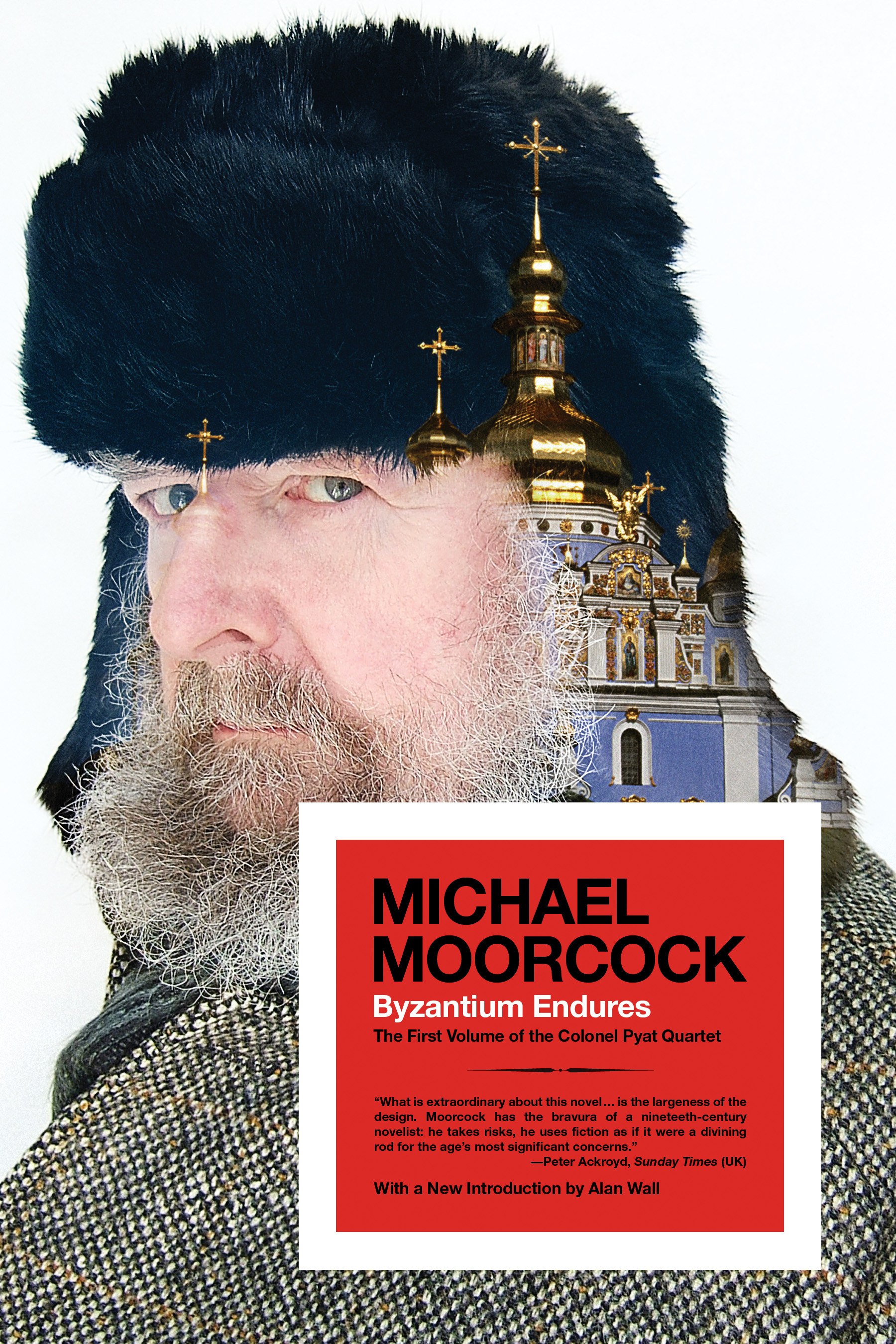
Colonel Pyat is a character who crops up from time to time in Michael Moorcock’s formally experimental Cornelius Quartet, although if I’m honest I don’t recall much about him from those books. He just seems to be around, one of a shifting cast of multiverse travellers that are sometimes the allies and sometimes the adversaries of the mutable Jerry Cornelius. Supporting characters there don’t need to present the reader with much in the way of interiority – the narrative is a tissue of morphing surface detail in which the question of fundamental reality seems moot. The Pyat in those books is an aggregate of visual signs and mannerisms, but the one found in Byzantium Endures is hard to pin down for the opposite reason. He’s all interiority, and we’re never sure when his rambling first person narrative is grounded in the diegetically objective, or when it’s radically delusional.
Keeping that in suspension is quite a trick, because whatever the author wants (and at the end of the day, who cares what the author wants) readers are prone to make up their mind one way or the other. There are times when the irony becomes more laboured, and descriptive passages when there barely seems to be any distance between narrator and authorial voice, but somehow Moorcock manages to keep the uncertainty alive – if you know Pyat’s velocity you can’t know his location. He is a self-aggrandising bigot, racist, and pan-Slavic chauvinist, so we’re never likely to mistake the narrative voice for the authorial, but the latter stays out of it, by-and-large. Pyat’s perceptions are plainly mistaken, warped, or even psychotic, but they are the only lens through which we get to examine the world of the book.
And yet we are reading a historical novel, meticulously researched, offering a detailed depiction of life in several cities in Ukraine and Russia at the end of the Tsarist era, and then of Pyat’s panicked peregrinations through the chaotic factional struggles of the two Ukrainian-Soviet Wars. That’s the diegetically objective field against which the figure of Pyat dances with his cargo of obsessions, desires and addictions. He’s a young man in this book, born at the opening of the twentieth-century, twenty years old at the close of the narrative, and his tale is a pretty mimetic account of the struggle we all face to make sense of the society we live in and the expectations it has of us. The plotting is linear, and the technique is realist. It’s an easy book to follow, if not easy to read – Pyat’s actions and attitudes, as well as the brutalities he witnesses, make the experience a bit like chewing a lemon at times.
Clearly, it wasn’t meant to be fun. This is an exploration of the ethno-nationalist discourses that led to the horrors of the Holocaust, and of the historical circumstances that inoculated enough people in Europe to brutality that it became a possibility. ‘Civilisation’ crumbles before Pyat’s eyes, the thin veneer of civility that had made a ‘normal life’ seem possible ripped to shreds by revenge and desperation. He chauvinistically ascribes this collapse to ‘Byzantium’ (the orderly Graeco-Christian world) failing to resist the forces of ‘Carthage’ (non-Europeans, non-Christians, and especially Jews), but you don’t get the sense that Moorcock would quibble with his character’s horror at the savagery that engulfed Ukraine between 1917 and 1921. Byzantium endures is written with the methodologies of the comic novel and the picaresque, but it is rarely funny, and rarely entertaining. It is gripping, however, and absorbing, written with fluid and capacious prose, which only stutters and fragments when Pyat’s own psyche disassociates. For me it’s a technical tour-de-force, a considerable creative achievement, and a profoundly affecting story.


Leave a Reply