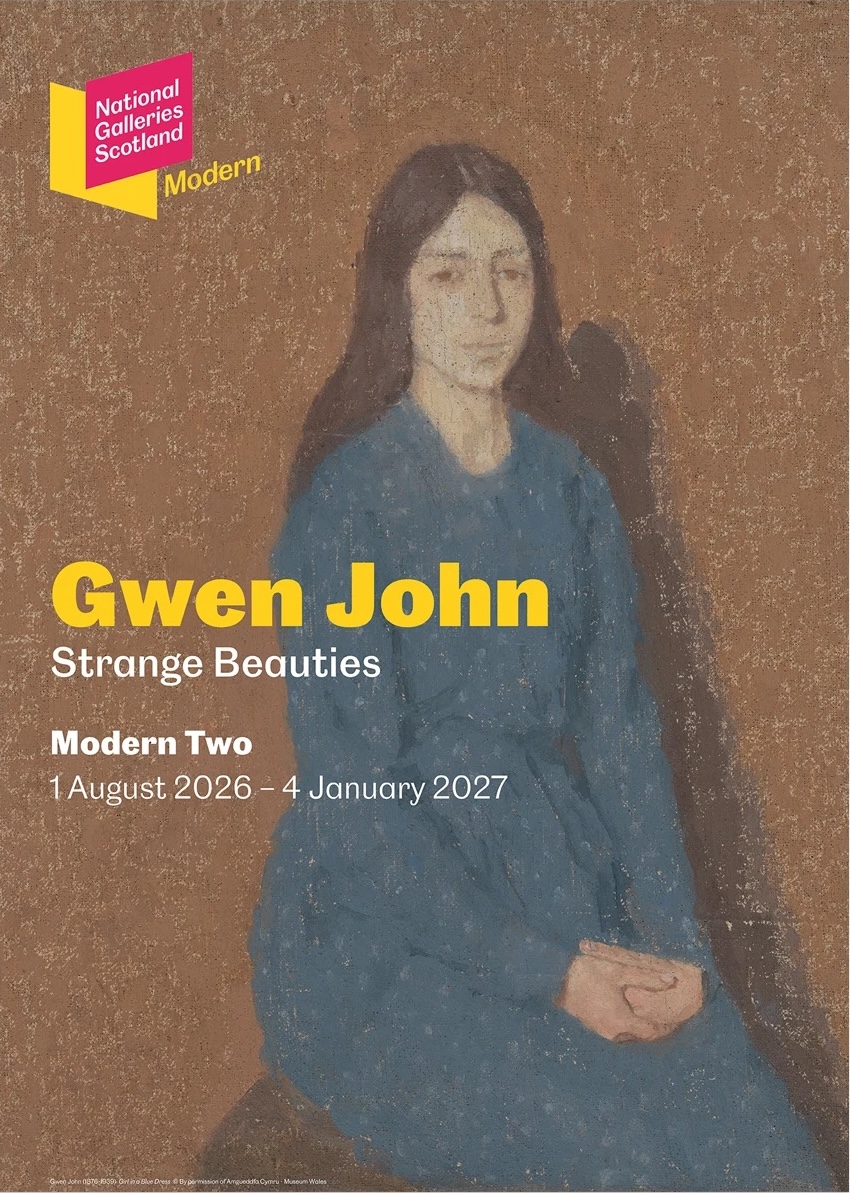
Gwen John is an artist I knew very little, other than a couple of her most iconic pieces. I knew she was Augustus John’s sister, undeservingly in his shadow for much of the time since their deaths, and I knew that Augustus John was a bohemian who wore big floppy hats and hung out with some other famous bohemians. Gwen John: strange beauties, at the National Galleries of Scotland’s Modern 2 site, has set me straight. It’s a maximalist career retrospective, covering every period in her life as an artist, and there are a lot of works in it. We nearly ran out of time just to get round and see each painting, forget about going back to look at the most memorable pieces, or a leisurely browse of the gift shop.
There are well-written and informative text panels introducing each gallery, which are painted in carefully selected colours to harmonise with the works on their walls – John tended to stick with a slowly evolving palette, and to work in series, revisiting the same subject repeatedly, so this approach works well. Every period of her life seems well-represented, although I have no idea if the work on show is proportional to her productivity at those times, or to the survival rate of her paintings. There’s a lot of work in each gallery. I also lack the knowledge to take issue with the art-historical account set out by the exhibition, but it tells a plausible and interesting story. Cats were among John’s favoured subjects, so some of her feline subjects have been abstracted from their canvases and put on transfers on the walls to guide visitors from room to room, which is an amusing touch. Art historical imponderables aside, the show is an accomplished piece of curatorial rhetoric, installed and displayed to the highest standard.
All of which fades into the background, as it should, when you see the work. John painted figures almost exclusively, mostly seated, never smiling, and almost always women. Well, there are the cats, but they are mainly alongside the human sitters, or in small studies: the finished, hangable, saleable paintings are anonymous women, meticulously realised in an obsessive pursuit of solutions to artistic problems. Most of them share a sense of calm, of self-possession, of waiting for the viewer to make the first move. They don’t really resemble portraiture, except at the most superficial level – the contract with the viewer is different. We are not expected to know who these people are, or to compare their image to the one in our mind. We’re supposed to see the painting, not the narrative that we suppose might surround it.
Spouse wrote a dissertation on John at art school, some decades ago, and at the time there were no books about her – she had to rely solely on texts about Augustus John. Gwen John had only one solo show in her lifetime. She was known, and she was able at times to make all of her living from selling her work, but she didn’t have anything like the recognition that, on the evidence of this exhibition, she richly deserved. We get to see her technique evolve, from the classical rigour taught to her by Henry Tonks at the Slade School of Art (the only art school to accept women students at the time), to freer, more experimental approaches, and to her distinctive mature style, where paint is applied thickly with very short brush strokes. Throughout these phases she’s looking for something, and seeing her work for the first time as a whole like this, there’s an unmistakeable impression of progression and enquiry.
What she was looking for only she could tell us. She was systematic in her approach, paying close attention to colour theory, and developing a numerical system of tonal notation still undeciphered by art historians. Her brushwork was extremely precise and nuanced, at each stage of her development, and as time went on she became more likely to revisit a subject, sometimes painting dozens of variations on the same sitter in the same pose. I guess she was looking for some kind of visual truth that went beyond mere optical verisimilitude. Almost all of the work is uncomplicatedly representational, but there’s something about it that is unmistakeably modern. Her simple, quiet figures clearly belong next to the flamboyantly abstract work she was hung with at the legendary New York Armory Show in 1913, not the conservative post-Impressionism of painters like Tonks, which it might more superficially resemble.
Eventually she needed to go further than the painted surface in her pursuit of truth, and converted to Roman Catholicism. She continued to paint, often sketching in church, and her pictures of French nuns cast a retrospective shadow of the numinous back over her earlier work. You can see there’s something below the surface, a kind of light, a kind of glow that belongs to protracted contemplation more than it does to the eyes and the world outside. It’s a curious fact that many of the artists and writers that have affected me most deeply have been drawn to Catholicism. Why that should be I have no real idea (I’m an atheist, although I have an aesthetic appreciation for RC ritual), but John’s paintings affected me deeply, in a way that’s not dissimilar to the science-fiction novels of Gene Wolfe, or the poetry of Gerard Manley Hopkins. There’s something beneath the surface of things, and it matters.


Leave a Reply