From the Latin verb teneō, ‘to hold’, we get the word ‘tenement’, which originally meant a land holding. How and when it came exclusively to refer to purpose-built apartment blocks is less clear (or I’m too lazy to research it), but patterns of ownership and tenancy still reflect the feudal origins of the term for many residents today. Miss Agnes Toward, who lived at 145 Buccleuch Street from 1911 to 1965 rented all her life, although as a single, gainfully employed woman of the clerical classes we might have expected her to own her home – expectations were different in her time, especially in cities. She was 78 years old when she had to leave her home for hospital, but she paid rent on it for the remaining ten years of her life, and a very astute woman by the name of Anna Davidson managed to buy the house intact with its contents. She sold it on to the National Trust for Scotland, and it opened as a museum in 1982.
It’s one of those stories of improbable happenstance, like the fossilisation of a bird feather in a tyrannosaur coprolite, which can’t be anticipated, but preserve something immeasurably valuable against all the odds, and all the brutalities of time passing. Of the millions of lives spent in tenements in Scotland in the first half of the twentieth century, Miss Toward’s is the one that happens to have been archived for us, not only with her furniture and personal belongings, but with the documentary record she accumulated as a bill-payer, theatre-goer, letter-writer, recipe-recorder, and all the other written activities that make up a human existence. It reminds me how precarious our history is – what’s always preserved is the record of political leadership, wars, dynastic progression, and big economic trends; but the real history, the sum of human experiences that make up a society, is rarely valued until it’s too late to save it.
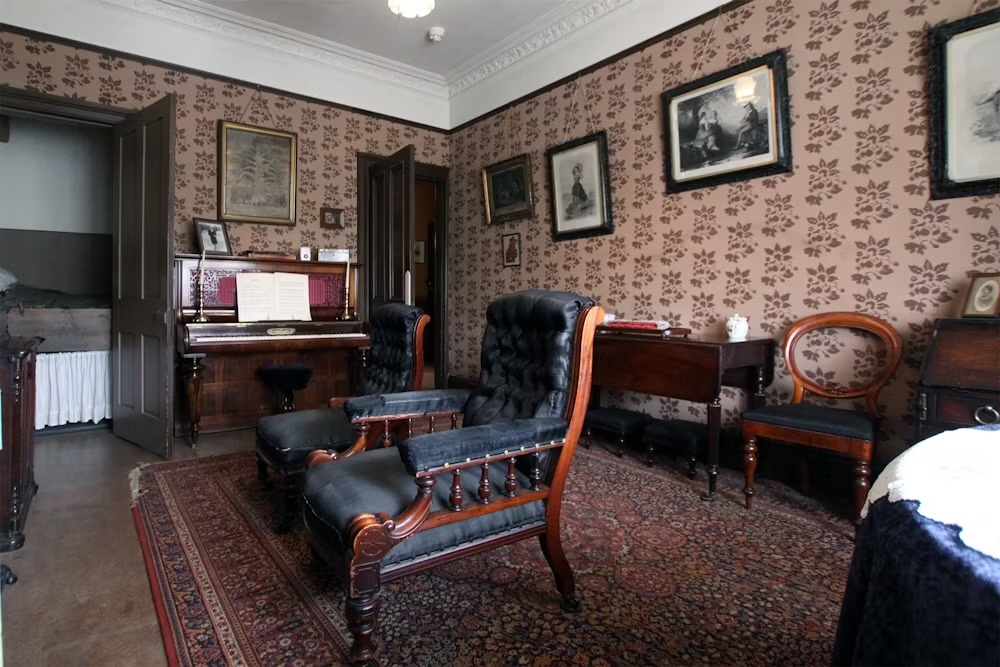
The pattern of ownership described above may be the reason for this extraordinary level of preservation – as it wasn’t her property, Miss Toward was reluctant to spend much on modernising it, and didn’t have electric lighting installed until 1960. The National Trust removed it and restored the original gas lighting when they took over, but probably had very little else to do. The tenement today is exactly as it was lived in – homely, respectable, cosy, and decorated with a coherent aesthetic sense. The downstairs flats have been converted into a gift-shop, café and exhibition space, with photo- and text-based displays giving a good sense of the social context before the visitor goes up to look at the first floor apartment. I can’t speak to the displays’ historical rigour, but they’re very effective in giving a sense of what lives were like then, and drawing a few lines to connect them to our own.
I’m old enough to have seen houses with gas-lights and solid-fuel ranges, so Miss Toward’s life probably seems a little closer for me than for someone younger, but hopefully every visitor will be able to feel the reality of the life that was lived here. This is a home, an accumulation of choices, habits, and accidents that prints a person into a place like a potter’s thumbprint on the base of a jug. That may sound sentimental, but I think its truth will be clear enough to anyone who’s had the heartbreaking task of dismantling a home after the death of a loved one. Miss Toward is still here at Tenement House, and it was a privilege to visit her.


Leave a comment