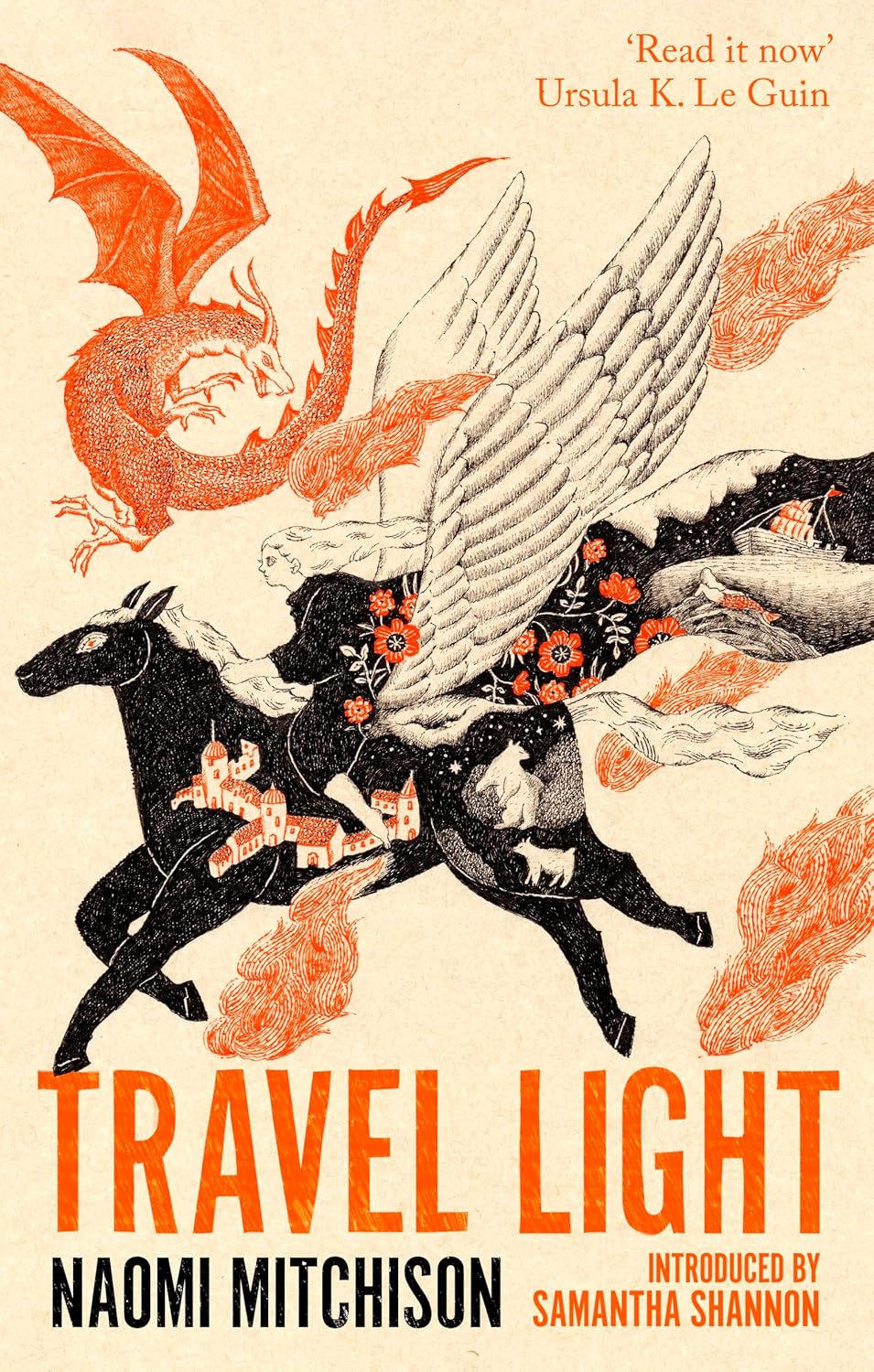
Serendipity can bring you some wonderful writing, if you let it. This book was returned at the library where I work, and I took note of a cover blurb from Ursula K. Le Guin, saying ‘read it now’. Any endorsement from Le Guin will get my attention, but an injunction like that is to be obeyed, in my opinion. I have to admit that I had never heard of Naomi Mitchison, which is my own failing, and a failing of British culture in general, as she is little remembered, despite seeming to have been both a remarkable writer, and an extraordinary human being. Travel light is a beautifully crafted fable, which appears to be a children’s or young adults’ novel, but which is freighted with subtleties few younger readers will note.
It’s a short fairy story, with its roots in Norse mythology and its branches in the historical milieu of the Byzantine Empire. The style is that of a fable, slightly distant from the detail, but also quite attentive to the grit and sordid realities of the setting. It’s written in beautifully simple prose, euphonic and rhythmically balanced, that reads like… wait for it… Le Guin herself. I’ve always noticed that Le Guin’s language, especially in her early SF books like Rocannon’s world, owes a debt (one she freely acknowledged) to the epic tone and mythic lyricism of J.R.R. Tolkien. Reading this book, the other shoe dropped into place—if you’d told me that Le Guin had written it, I’d never have suspected the subterfuge – it’s interesting to note that Mitchison was a friend of Tolkien’s, and proofed parts of The Lord of the rings. There’s a stylistic tradition in twentieth century fantasy writing, largely articulated in the pages of what were considered to be children’s books, of which I’m relatively ignorant, but in which writers like Le Guin and Tolkien clearly participated.
I generally avoid ‘children’s books’, but this has not been republished to resemble one, and I don’t really regard it as such. A child will likely enjoy reading it, and the protagonist Halla is young, although she is old enough to consider marriage by the end of the story. It’s not as though there’s any overt sexual content either, or overly graphic depictions of violence, but there’s a lot going on thematically, much of it speaking to a wisdom that only comes from experience. Despite the mythical setting of the earlier chapters, it’s a harsh and adult world in which Halla finds herself along her journey.
Learning to ‘travel light’ is a difficult lesson – no child wants to hear that they need to discard their attachments, nor should they attempt to do so, but that’s what Halla does, because her journey is a spiritual one, and by the end she has jettisoned everything that appears comforting or splendid when it first appears. The attentive reader will understand what she has gained, and the book’s great achievement is in making that clear in a way that rings true whatever your religious beliefs, or lack thereof. Written with the gestural concision of poetry, this short, delicate tale is as insightful as it is beautiful.


Leave a comment