Alan Moore – plot; Leah Moore, John Reppion – script; Shane Oakley – pencils; George Freeman – inks; Wildstorm FX – colours; Dave Gibbons – covers; Todd Klein – letters; Richard Friend, Sandra Hope, Peter Guzman – additional inks; Tony Aviña – additional colours; Adrian Tchaikovsky – introduction.
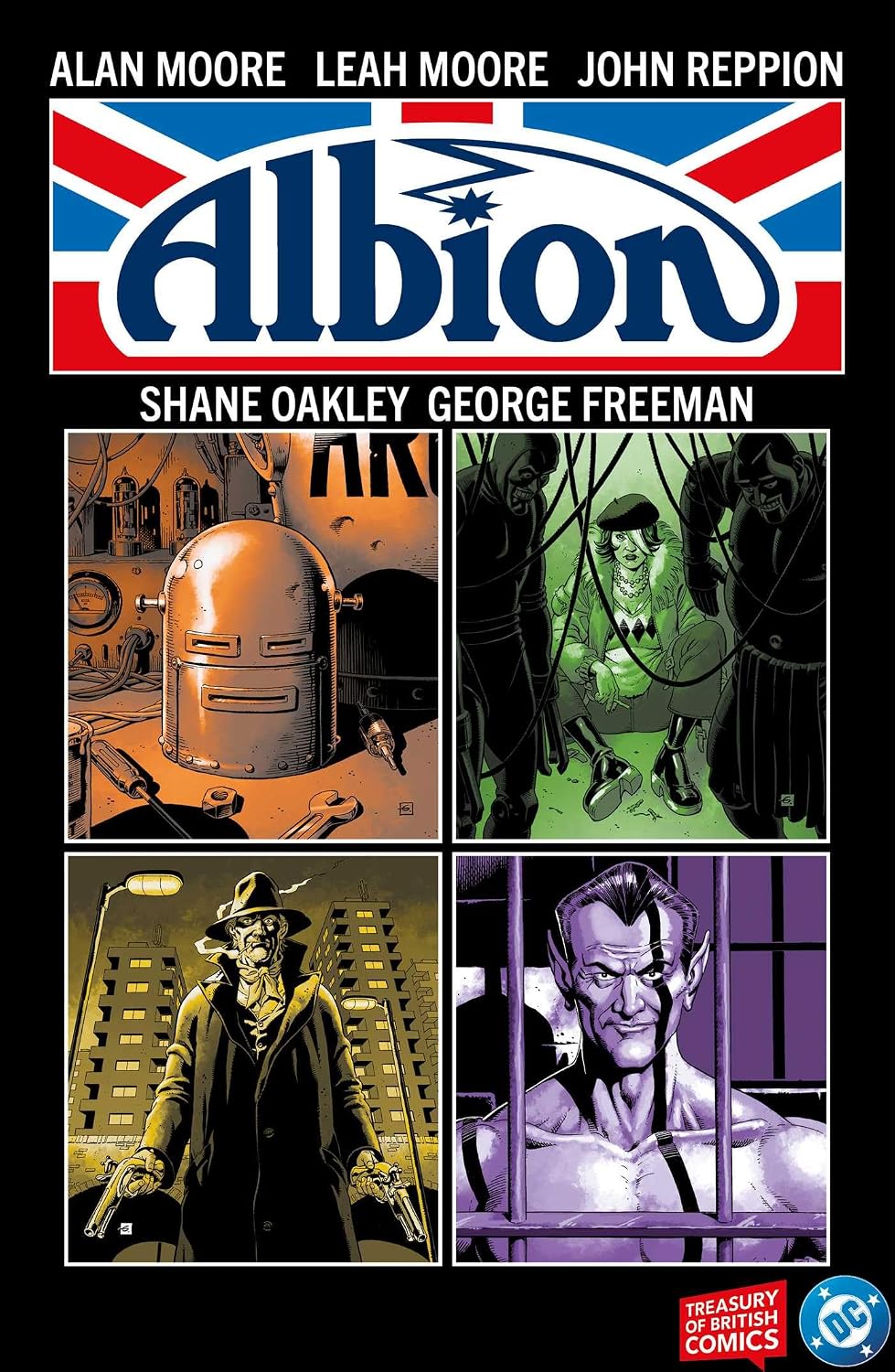
American superhero comics are, like the discipline of economics, a system of apologia for capitalism. What, they ask, if certain individuals had immense power by virtue of, say, radioactive spider bites, or birth? Wouldn’t that be cool? They could wear tight clothing and defend society against threats to private property. They’d certainly have our best interests at heart – except for the bad ones, but the good ones would always beat them in a fight, because right makes might. British comics have different emphases. A lot of the heroes in post-war boys’ comics emerge from nostalgia for Empire, or simply nostalgia for WWII, the last time in British history that we all had something important to do and succeeded in doing it together. Importantly, though, they tend not to have been produced by writers and artists who really bought into all that schtick, and alongside the derring-do there was always a significant stream of irreverence and subversion.
They also sold far fewer copies, and while American characters introduced from the 1930s to the 1960s are still in print and all over cinema screens globally, the Brits have mostly sunk without trace. Dan Dare, Roy of the Rovers and Archie the Robot are the only ones I can think of that still have any traction in popular memory, other than the denizens of The Dandy, The Beano, and 2000AD, all of which are still running. Who remembers Captain Hurricane now, or The Spider, Bad Penny, Charlie Peace, or Zip Nolan? Mostly people in their 60s and 70s, as all of those and a host of other characters had been cancelled by the time I started reading comics in the mid 1970s. But do you know who does remember them? Alan Moore.
Alan Moore enjoys spinning superannuated characters up into a shared universe, where he can subject them to his own brand of radical reinterpretation, and lock horns with the often objectionable ideologies that informed their original manifestations. This is what he did with The League of Extraordinary Gentlemen, which he’d been writing for over five years before the first issues of Albion were published. It’s also more or less what he did in Watchmen, for which he developed his own characters—there’s not much mistaking the millionaire crime fighter with a basement full of vehicles and tech, and branding based on a nocturnal flying animal for anyone other than Batman though. Whenever he’s been given an established character to play with, Moore has tended towards a revisionist approach, and that’s exactly what he did when he developed the concept for Albion. Here though, he really goes for it—the aforementioned Bad Penny was basically a version of Minnie the MInx (both beret-wearing urchins were the work of Leo Baxendale), and several other characters are drawn from the cartoony, infantile end of the children’s comics market.
Moore plotted this series, but he didn’t have time to write it, so those duties fell to his daughter Leah Moore and her husband John Reppion. The plotting is designed to highlight the tension between imperialist and anti-establishment ideologies that was so evident in post-war British comics, with some of the era’s more goody-goody characters working for the government, and responsible for locking up and concealing the existence of the more anarchistic or destructive ones. The writing is propulsive, amusing and effective, although it feels as though its points could have been made better in a slightly longer book/series. If you’d told me it had been written by Alan Moore, I’d have believed you, although he’d probably have injected it with more conspicuous virtuosity – I’m not saying I don’t like it when he does, but he definitely enjoys showing off.
It’s the art that makes this book really worthwhile, though. I don’t know whether Moore fille and Reppion took Moore père’s approach to scripting – Alan Moore was notorious for the detail with which he would describe scenes and layouts, or whether Shane Oakley is responsible for the layouts and the fantastically rich and referential detail that’s to be found in almost every panel. I also couldn’t say how much of the style of the finished artwork is down to Oakley or inker George Freeman, but somebody there is a great stylist, pushing cartooning in an angular, avant-garde direction that bears comparison with British greats like Mike McMahon or Alan Moore’s collaborator on the League Kevin O’Neill. I’m not familiar enough with either artist’s work to say whether I think the style belongs to one or the other of them, but they also add up to far more than a one-trick pony, as can be seen in the several pages aping the styles in which their characters were originally drawn. The art is expressive, dynamic, and atmospheric, using black ink wonderfully in a way that sometimes reminded me of Jaime Hernandez.
I completely missed Albion when it first appeared between 2005 and 2006, so this reprint is very welcome. The title is a joint venture between DC Comics and Rebellion, reprinted under the latter’s Treasury of British Comics imprint. When Rebellion (a videogame developer) bought 2000AD in 2000 AD, they were required to sweeten the deal by also buying the rights to a vast archive of discontinued British comics, which the vendor didn’t really know what to do with. They’ve shown a real sense of cultural custodianship in the years since, with a series of high-quality reprints bringing important but unobtainable British comics to new audiences, but that was barely under way when they licensed the characters for this book. Albion is exactly the sort of archival project that’s needed, if that important aspect of British culture is to survive – Rebellion won’t keep this stuff in print until the end of time, but every high quality, hardback, internationally published reprint like this one represents a durable entry in copyright libraries around the world, and helps make what might have been vanished ephemera into a substantial piece of cultural history. Also, it’s a gratifying rejoinder to the ideologically conventional fare that makes up most of the superhero comics scene today, and a rambunctiously entertaining read.


Leave a comment