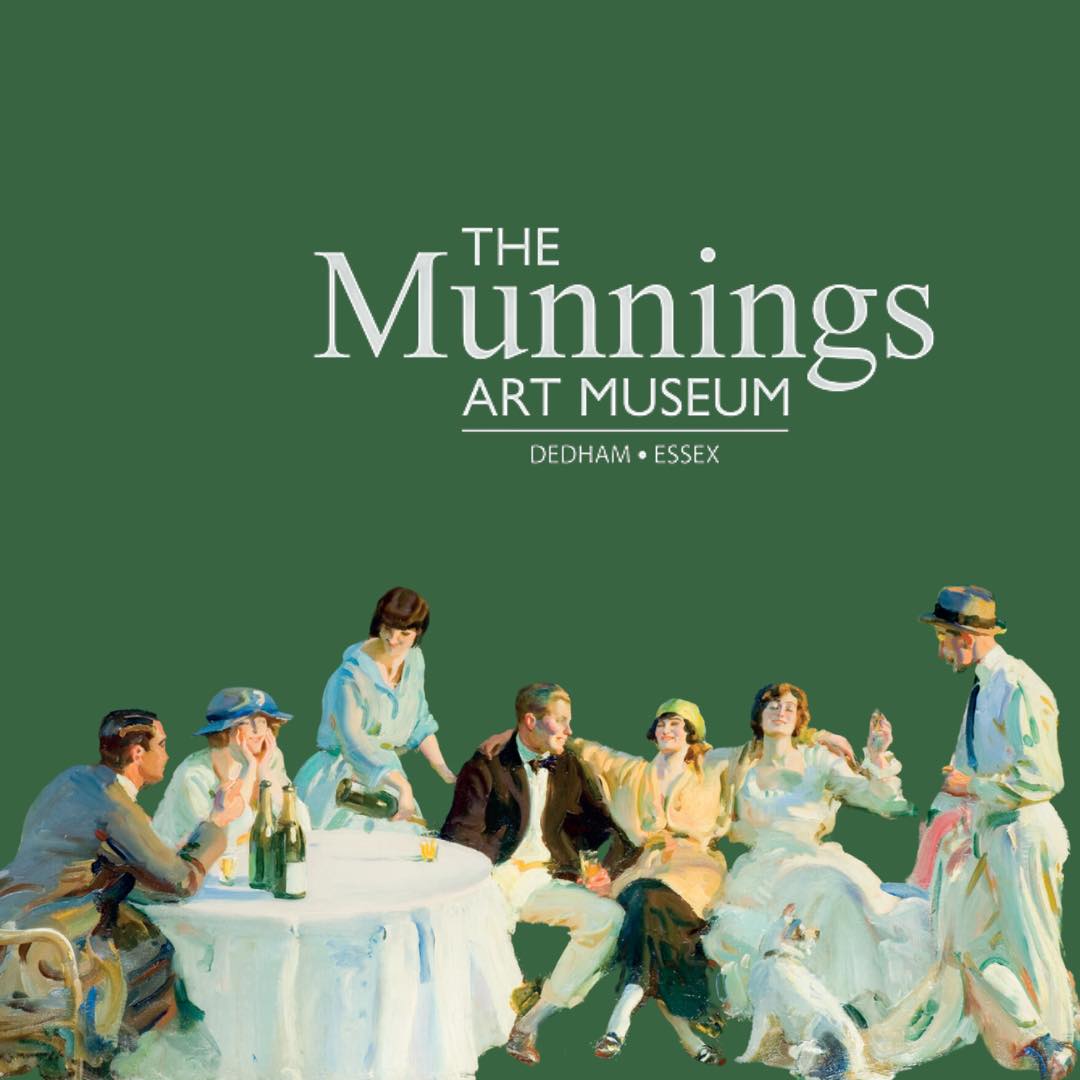
I live in a part of the country associated with painters. I’m sure that most parts of England are associated with painters, but I’m lucky to have a couple of famous ones closely linked to the area I live in, John Constable and William Gainsborough. Gainsborough was a successful portraitist, but both are well-known for their landscapes. Less famous is Alfred Munnings, who was best known for his portraits and his equestrian paintings, but who his wife was quite convinced was Constable’s reincarnation. There is a museum dedicated to his work in a village very near to my home, which it shames me to admit I have only now visited for the first time, in the more than thirty years I’ve lived in the area.
Munnings is less famous than his fellow luminaries of the Essex-Suffolk borders largely because they were groundbreaking painters, paving the way for the arrival of the modern with their increasing emphasis on the visual impression and the materiality of paint. Munnings was something of a conservative, painting through the first half of the C.20 in a style that would have looked radical in the 1870s, but which was conventional and unchallenging to the tastes of his time. However (and I’d heard that he was good), he was a breathtakingly skilled craftsman, who mastered the techniques he inherited, and made everything he did look easy. Looking back now at two paintings, both using very similar techniques, both perfectly evoking the visual impression of a natural scene, both virtuosic in their use of paint, one painted in the 1880s and one in the 1920s, it’s quite hard to buy the art-historical assessment that the earlier one (perhaps a Monet) is important, and the later is uninteresting. Perhaps the art-historical significance of a Munnings is in what it can tell us about the impact Impressionism had on artistic practice, which seems to me to be worth thinking about, but the in-your-face aesthetic value of the painting right in front of you is that it is beautiful, and that the technique it embodies is dazzling. I know it’s unfashionable to get excited about skill, but for me art is more than a discourse—it’s a practice of making and a tradition of training. To separate these from the discourse or art seems strange, especially if it stops you enjoying work as entertaining as Munnings’s.
We started in the studio, which is in the garden next to the tea room, and the work displayed in there is commercial art. When you realise that Munnings began painting images for reproduction as posters and advertisements, it gives you a handle on the way that his wall-work looks. He was apprenticed at fourteen, and learned his trade meeting the needs of clients. I imagine that to Munnings, art looked the way it looked to a painter in the Renaissance—any distinction between ‘commercial’ and ‘fine’ art was relatively meaningless. There’s a pragmatism to his work, even the more abstract landscapes or cloud studies—there’s nary a wasted brush-stroke, and every line conveys a whole paragraph of form and movement. Some of his portraiture, especially the group pieces, looks very much like illustration, emphasising its narrative content through body language and facial expression—if comics had been a respectable form in his day he’d have been a great exponent!
The house itself (which is the house he lived in until his death in 1959, only two years before his wife opened it as a museum) is absolutely rammed with his paintings. The majority are equestrian portraits, which made his fortune and gave him his entrée into high society. He was friendly with the Royal Family, president of the Royal Academy, and knighted for his services to making rich people look good on horseback. The collection includes around six-hundred paintings, many of them quite large, so the displays are changed annually, which encourages return visits. When we visited there was a small gallery of works on loan, one of which was of the next place you come to if you leave Stoke-by-Nayland past my house, Steps Farm. It turns out that Munnings’s father grew up in Stoke-by-Nayland—another unexpected connection to add to the artistic coincidences we’ve been collecting lately.
Munnings more or less destroyed his reputation in fine art circles with his valedictory speech on retirement from the Royal Society, in which he wrote off the whole of artistic Modernism as worthless and ridiculous. I guess he’d forgotten how avant-garde the techniques he used had once appeared, but it’s really neither here nor there when it comes to the work. He’s a footnote in art’s history, as he didn’t really bring anything new to the table, but his paintings are a joy to look at, and a fascinating window into the lives of the county set in the first half of the twentieth century. I bought a season ticket, as I’m sure I’ll be back.


Leave a comment