Well, so that was a Worldcon. Oof.
I mean, it was wonderful. It was intense. It was people. It was information. It was magic. It was science. It was huge. It was joyful. It was exhausting. I haven’t quite put it into order in my head yet.
Worldcon, if you don’t know, is the World Science-Fiction Convention, at which the well-known SF writing accolades the Hugos are awarded. It takes place somewhere different each year, and this year it was in Glasgow, a city I love, and in which I have close friends. Of course I went. I’m in my second year of attending conventions, and Glasgow 2024: A Worldcon for Our Futures was my third. It was an order of magnitude larger than anything I’ve been to previously, and knowing how lost I might feel, I made the decision ahead of time to get involved. In fact, I’d already worked out that this is the best way to enjoy a convention, but at one so enormous I figured it would be a survival strategy.
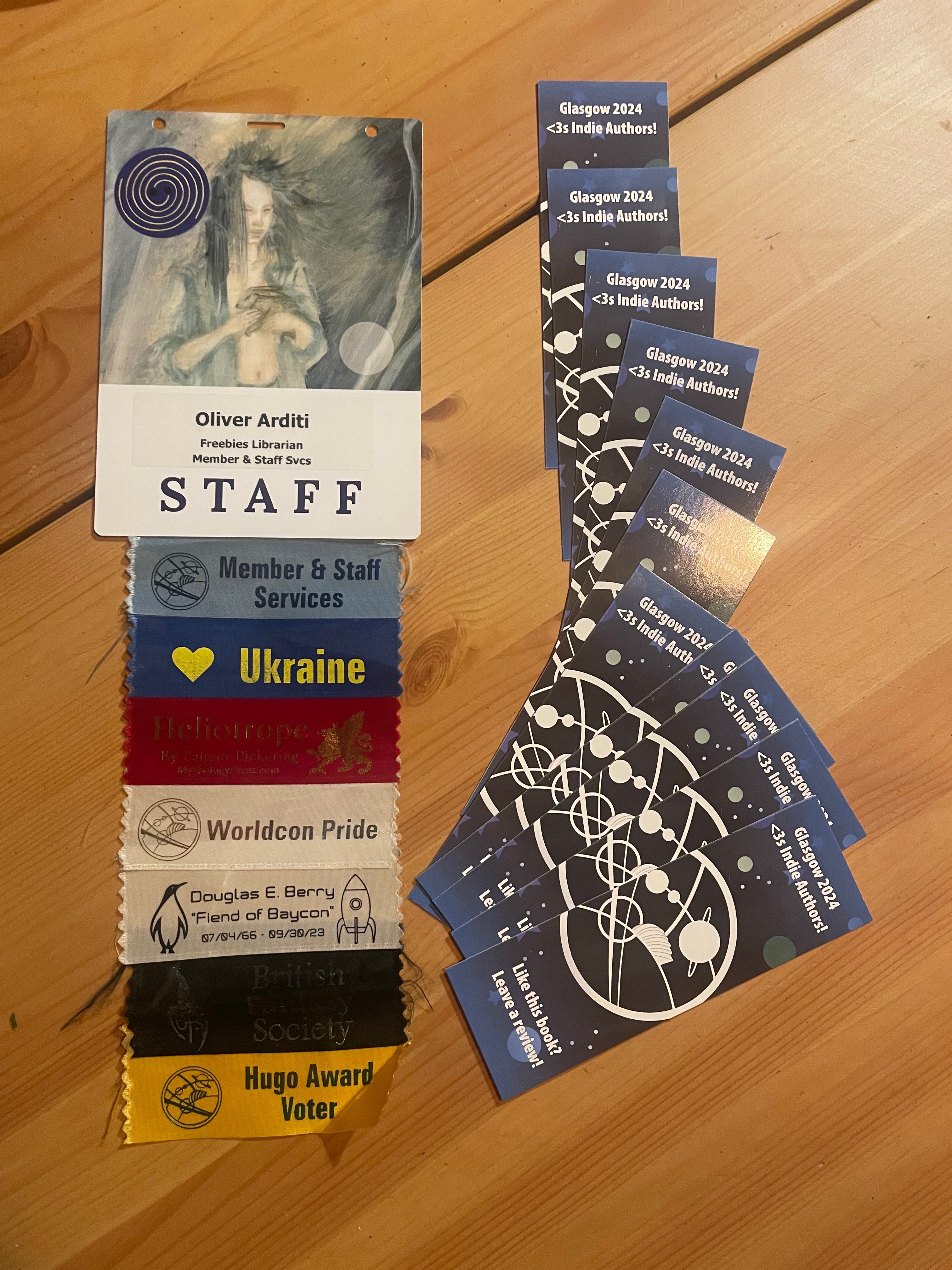
I filled in a form, telling the organisers what kinds of expertise I have, and what kinds of experience. To be clear, my experience of volunteering on convention staff is zero, and I made that explicit. However, I have a fair amount of experience in public libraries, which is probably why I was offered the post of ‘Freebies Librarian’. This position made me responsible for a small corner of this Worldcon, a space for the distribution of the free books and other merch that are often given out at conventions. I don’t want to spend too much time talking about what this involved, but it gave me the privilege of a look directly into the intricate organisational gubbins of this enormous, voluntary machine, and the immeasurable satisfaction of helping to make this wonderful, improbable event take place. At some point, it had been decided not to give out freebie bags, as is often done, and instead to have a space analogous to a public library. People could withdraw books (without having to bring them back), and sit around reading in a pocket of calm amidst the hurly-burly of seven-thousand nerds nerding out. This is roughly what happened—I think, in general, that it was a great success, and a lot of people really appreciated the space.
An assistant for the rookie
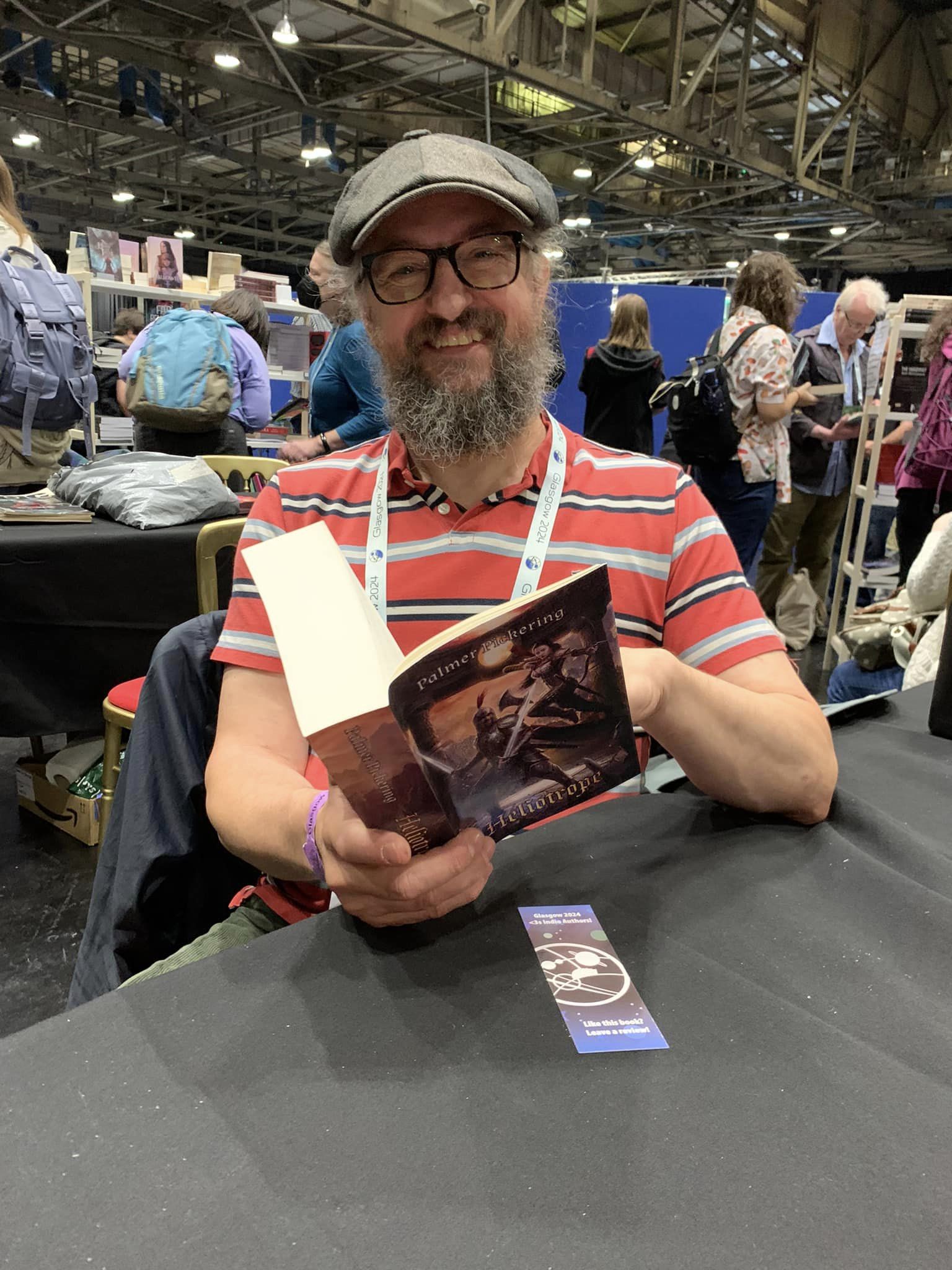
In the lead-up to the convention, I was given an assistant. Or rather, one of the independent authors that enquired about sending stock to the Freebies Library, offered her services as a volunteer. At this point, I was slightly concerned that we were going to be short of stock—I had expected the big traditional publishers to flood us with books, and that didn’t seem to be happening. My new assistant (or ‘apprentice’, as she asked to be called) was Palmer Pickering, a well-established independent author, and all-around excellent human being. She reached out to her network of independent writers, and the Freebies Library took on a new kind of life.

So many self-published authors sent us stock, at their own, often considerable expense, that half of our shelves and one of our tables were entirely stocked with their books. This was completely transformative for the Freebies Library, both in terms of saving our bacon, and of making it into a new kind of space. Palmer is deep into that world, but because of the way it works, she mainly only knew those people online, and the Worldcon weekend became an opportunity for her to meet many of them in person, as many delivered their books to us by hand. We had bookmarks printed to express our appreciation, and to encourage readers to leave reviews, which are the lifeblood of that word-of-mouth literary ecology. The Freebies Library became the default indie author space at the Glasgow Worldcon.
A portal to indie-space
I don’t really know much about the self-publishing scene. I know that it’s big, and growing—I don’t have my fingers on the authoritative figures, but I’ve seen it suggested that more than half of the e-books sold are self-published, and a considerable proportion of paper ones. What I do know, is that I’ll almost certainly be a part of that. Of course I’d love to get an agent and a traditional deal, but even if I do, a lot of what I write is never going to be that attractive to a trad publisher, and like many writers today I expect to pursue a hybrid career. What I learned from my ‘apprentice’ Palmer (I learned far more from her than she did from me, I’m sure!), is that indie authors don’t really have spaces of their own yet. This is true in distribution, bookselling, libraries (as I can certainly attest), and also at conventions, although many people involved in running conventions are extremely supportive of the indie scene. Of course the indies carve out spots for themselves where they can, and they have developed thriving online communities, but the fact is that the rest of the world needs to catch up.
For example, in the library service I work for, there is an effective total ban on indie books. We are run by a fairly typical, risk-averse local authority, and those that set our policies at the highest level are afraid to stock and promote books that have not been through the editorial processes of the traditional publishing industry. They don’t want to risk the blowback if somebody borrows something and discovers that it hasn’t been looked at by a sensitivity reader, or if it contains offensive political views, for example. Given the kind of organisation we are, I completely understand this position. The gatekeeping mechanism is straightforward—you have to be distributed by the supplier from whom we buy our new books. This is achievable for many small presses (I don’t know the detail of how you get on their list), but it’s out of reach for the truly independent self-published author. This policy is all very well at the moment, but it’s going to become increasingly untenable if the indie market continues to grow (which I’m pretty sure it will). Somewhere down the line we’re going to find that we don’t stock most of the books that readers want. I don’t know what the solution to that will be—perhaps some kind of quality mark, but that would inevitably entail a significant cost to authors, as it would require their books to be read by people with editorial expertise, and those people have bills to pay.
Time for a salon des indépendants
I do have a couple of concrete ideas for conventions, however, where the battle is more than half won. Indie authors are already a valued part of that world, and have been a visible presence at the conventions I’ve attended. They don’t face the kind of hurdles they may in public libraries, but they do face some structural obstacles by virtue of the fact that they are a bunch of individuals, without the critical mass of a traditional publishing house, or even a small press. Based on my experience at the Glasgow Worldcon, I can see two simple interventions that would help to make those obstacles go away.
Firstly, we should give them (us) a designated space, like the Freebies Library. Clearly, Worldcons are very big, and smaller conventions are not going to be able to accommodate anything on the same scale, but a table and/or a bookcase, and a couple of chairs for people to sit and read in might be an achievable provision. This space could serve both as a freebies distribution point, for those authors that think giving away some books would help them to gain readers, and as a spot in which indie authors and readers could mingle and talk. A couple of set times for meet-and-greets over the course of a weekend would maximise the opportunities for community building.
Secondly the practicalities of going to a con as a dealer don’t necessarily favour the individual indie author. You don’t get to go to any programme events, as you’re on your table all day, and if you’re just promoting your own titles you may well not make enough sales, or find enough new readers, to justify the expense. However, if convention organisers designated a single table for indie authors, and let them buy space by the title, I’m pretty sure it would be possible to find enough volunteers in the community to staff it through the weekend, without anybody getting stuck there and losing the opportunity to network and attend panels.
Additionally, Palmer suggests that independent authors could be better represented in convention programming. Here’s what she wrote in an email to me:
‘An additional suggestion I have for con organizers to help indie authors is to perhaps create a programming track specific to indie (self-published) authors. There was very little representation for indies in the programming [at Worldcon] this year, and if indies are indeed responsible for a good portion of SFF sales, this is a disservice to readers and authors.
There could be a series of indie panels in the following categories:
- By genre, to introduce the audience to up and coming or established indie authors and their books.
- Promoting indie authors with inclusion in signing events and author Roundtables
- Panels on the mechanics of self-publishing—writing drafts, editing, proofreading, beta and ARC readers, formatting, illustrations/cover art/maps, print-on-demand, pros/cons of DYI vs hiring experts in editing, formatting, art, etc.
- The business of self-publishing—hiring editors and illustrators/graphic artists, costs for publishing and distribution, marketing, expectations of cost and revenue.
- Marketing in general—websites, community building, networking, contests, book signings, promotions/ads, getting your books into stores and libraries, distribution options, etc.
Each of these topics is vast and is quite different from working with a trad publisher, who presumably handles much of this for authors—although there is some overlap, especially these days when trad authors are expected to do their own marketing to a large extent. The learning curve is steep and the landscape keeps evolving. New and even established authors like to trade info on all this stuff.’
But what do you think?
I’m putting all this out there with the benefit of very little experience, and without knowing what kinds of discussions are already taking place among organising committees. I could ask, of course, as I know quite a few of those people by now, but actually, that’s what I’m doing. This article is intended as a conversation starter. I spoke to a bunch of indie authors at Worldcon 2024, but I’d be very interested to hear what they, convention organisers, and others think of these ideas specifically. Glasgow 2024: A Worldcon for Our Futures (to give it its full title) was an absolutely mind-blowing event for me, in innumerable ways, but if I took home one overriding insight, it was this. The indie author community is hugely important, and the more things that are done to facilitate its growth and cohesion as a community, the better it will be for all lovers of books, reading and writing. Please reach out and tell me what you think.
 Oliver Arditi