Hell is other people, or networking for writers
It has been suggested that hell is other people. For someone struggling to write, that might well seem to be the case—if only they would stop distracting you, if only they would stop saying things and wanting things, then you might get something written. Myself, I’ve found that a pair of good headphones and my laptop are the only accoutrements I need to make myself sufficiently alone to write, but such strategies are a discussion for another day. Today I want to suggest that hell is writing, and other people are the only way to make it bearable.
Hell is writing, or why you should meet other writers
The benefits of networking
I’ve recently finished the Open University’s creative writing MA, a course which I came to after many years studying the craft. For all that I have nothing published to show for my efforts, I’ve been at it for a while, and most of the specific things that the course materials had to say about the practice of writing fiction were ideas I’d already encountered and engaged with in detail. The course provides a supportive context for developing writers to find out what it is they need to be writing, but again, I already knew that, and I was already doing it—most of the work I submitted for assessment had already been written before the course started. The truly invaluable thing that the course provided for me, something that I hadn’t even realised I was lacking, was the company of other writers. Discussions held in my tutor group forum in relation to course exercises gave me a novel insight into the ways that other writers understand and approach the art of fiction. More informal threads in the ‘Student Café’ forum gave me the opportunity to share the experience of writing with a group of people from every walk of life, across a whole demographic range. The more I gained from these interactions, the more clearly I came to understand that I was lonely.
I have a wonderful family life, and I have a circle of good friends. I’m fairly reclusive by inclination, and the strange events of 2020 have perhaps exaggerated that tendency, but I’m by no means socially isolated. However, writing is a peculiarly isolating activity. We scribble away in solitude, with nothing but the blank desert of the unwritten page for company. We spend days in struggle, climbing mountains in our heads, and at the ends of those days the people in our lives ask us how it’s been going. ‘Oh, fine,’ we say, and turn on the TV, as though everything was normal. It was only when my isolation was alleviated that I became truly conscious of it.
And here’s the thing: that helped me to write. Having someone to share the burden with, people who understood from their own experience what it felt like, and who I knew to be plugging away in the same dogged seclusion, helped me to keep motivated. Sometimes it’s even inspiring. I want to write good stuff so that I can share it with people who will appreciate the blood and tears it cost me to produce it. Hearing people talk about their writing has helped me to think about my own, and to maintain a little bit of critical distance from it. On every level I can think of, contact with other writers has made me happier, and made my writing better.
Oh no, I’m a weirdo! Or, how to find your people
Societies, fandom, and conventions
The Open University MA is run with a fairly mainstream point-of-view—genre writers like me don’t necessarily find all of the course content directly applicable to them. Earlier this year, I appealed to the tutors for some more genre-specific advice on the professional aspects of writing, and I was advised to join the British Fantasy Society (BFS), and the British Science-Fiction Association (BSFA). I did so, and it was one of the best things I’ve ever done. Through both organisations I’ve found online communities and events full of people who love to write and read the same weird malarkey that I do. I may be unusual among genre readers in having had no contact with the world of fandom—I honestly don’t know. But having found my way into that world, I’ve found a way to continue to enjoy all the benefits of writerly socialisation that I’ve discovered on my MA, which is now over.
So what is it that fan societies do? Well, lots of things, but most importantly, they get together. They hold conventions. I went to one. Fantasycon 2023 in Birmingham was my first convention, and it was an absolutely wonderful experience. I went on my own, knowing nobody, and came away feeling like I’d found my people. One thing I hadn’t anticipated, and that I’m sure isn’t the case at the better-known conventions, is that pretty much everyone I spoke to was either a writer, or involved in the publishing industry in some way. Fantasycon is the annual gathering of the BFS, and I guess it probably reflects the society’s membership in that respect (although by no means all attendees are members). I met a ton of people I fully expect to stay in touch with, and I attended innumerable panel discussions, at which I learned an enormous amount about the business of being a writer.
I specifically chose discussions on marketing and business over those on writing, as that’s the phase I’m moving into now, and I found the participants to be generous, articulate, knowledgeable, and often very entertaining speakers. I also attended the banquet and awards ceremony on the Saturday night. I’ve tended to be very down on industry awards generally, in whatever field, on the grounds that they can’t possibility represent a fair or comprehensive assessment of the ‘best’ of everything, but the British Fantasy Awards felt fundamentally different from something like, say, the Bookers. This felt like an inclusive and open-hearted celebration of the whole community. Perhaps I was getting a little misty-eyed by this point, but I can’t recommend the experience strongly enough. All the benefits I discussed above in relation to my MA were multiplied by the in-person intensity of the three days I spent at Fantasycon, and I can’t wait for my next dose (probably at the BSFA’s Eastercon next year). I’m clearly unqualified to comment on how this small-scale, cosplay-less convention might compare to other events of a similar nature, but I thought it was a total blast.
Is there anybody out there? Or, build it and they will come
Local groups: finding the people in your area
Before I braved England’s crumbling railway system to attend Fantasycon, I had already engaged with the BSF to the extent of finding out that regional groups are a thing, and that no, there aren’t any in my part of the country. Ditto with the BSFA. Largely through a past interest in roleplaying in online games, I’m already acutely aware that if you want something to happen, unless you live in a big city, you usually have to make it happen yourself. I’ve never felt any inclination to be the popular, big-shot social butterfly at the centre of things, but I’m willing to stick my neck out far enough to see if any other nutters are lurking in the shrubbery. I reached out to both societies, ascertained that they’d be up for helping me to promote something in East Anglia, and picked a date. Somewhat grandiosely, I started publicising a group that existed only in my mind, and calling it ‘The [yep, that’s right, ‘THE’] East of England Science-fiction, Fantasy, Horror and Speculative Fiction Society’.
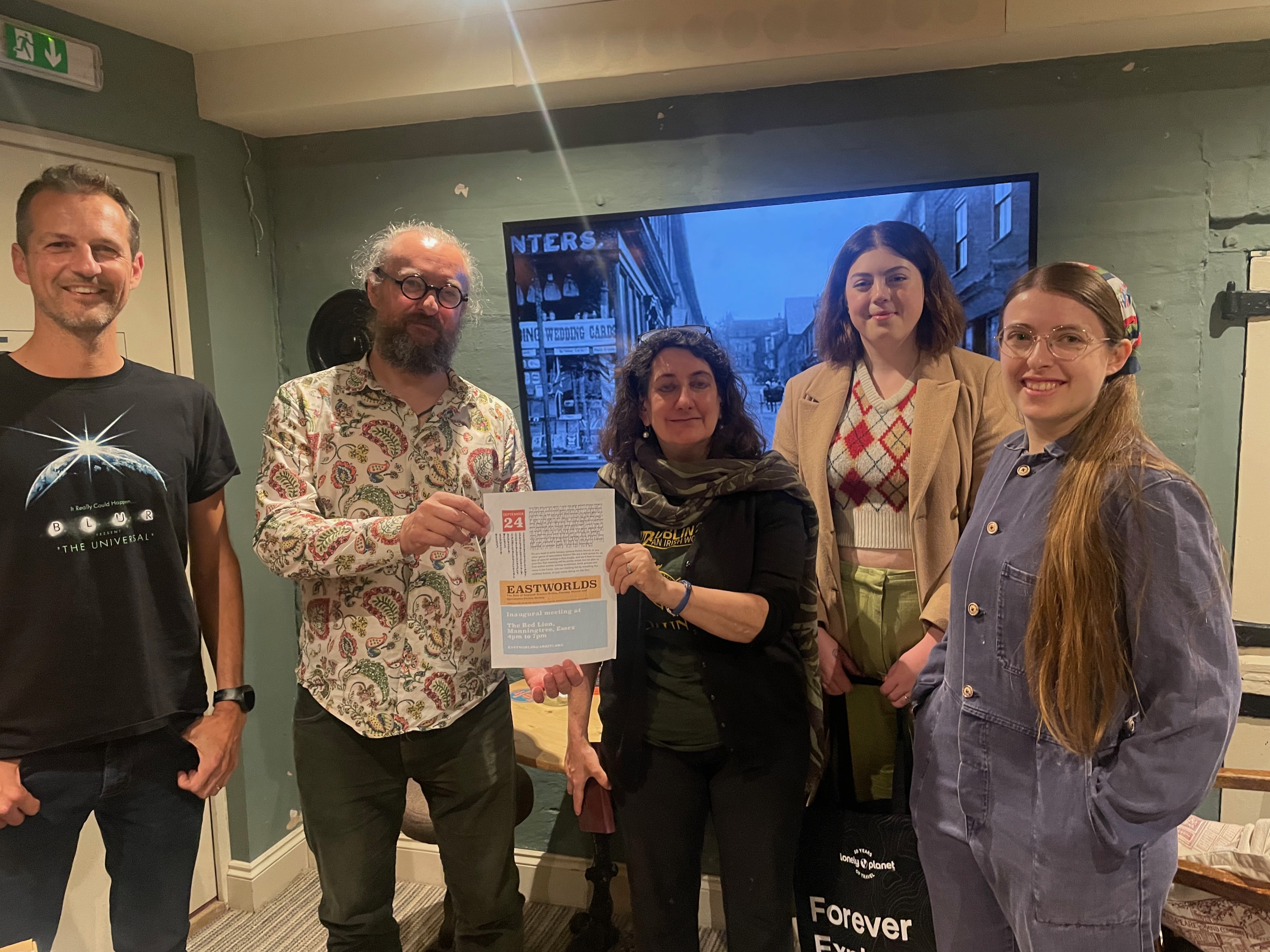
I realised I needed something snappy for a poster, and the portmanteau ‘Eastworlds’ popped into my head about 5 minutes before I started sharing it on social media. I’m well aware that some things are already happening in East Anglia, in places like Norwich and Cambridge, but neither the BFS or the BSFA could point me at a regional group, and rather than starting one called ‘The Rural South Suffolk Science-Fiction etc. Society’, I decided to aim high. I booked space for the inaugural meeting of Eastworlds in a pub in Manningtree (a tiny place roughly in the middle of the region, on the main rail line), mithered people about it on social media, and crossed my fingers. A handful of nice people turned up, and it was a great joy to sit and talk to them, and plot future meetings for a couple of hours. I learned a few things about fandom and how it works. One attendee turned up asking ‘is this fandom?’, and although I hadn’t really thought about it that way, I had to reply with an enthusiastic ‘yes’! Future events are likely to be in other locations around the region, and to involve a bit more structure (one suggestion was for outings to see SF movies, followed by time in the pub to discuss them), but despite the low numbers, I found our first meeting enormously cheering. If you happen to live in the East of England, then please join our mailing list, by emailing eastworlds@arditi.org
You’re not alone! Or, that escalated quickly
Becoming part of a writing community
So, from roughly last March, which is when I started to bug my tutors for science-fiction, fantasy etc. info (we need an acronym for these queer varieties of literature, maybe SFFH+?), until today, as I sit and reflect on the past months from a rather pleasant holiday villa in Sicily, I seem to have travelled a long road. I now know a few local SFFH+ fans and writers. I know some moderately successful SFFH+ writers and industry people that I met at Fantasycon. I know a bunch of people who are at the same ‘aspiring’ or ‘early career’ stage as myself. I have an idea of a UK-wide community of fans, writers, publishers and miscellaneous professionals, who have their own institutions and traditions, and a calendar of events. I know that I’m the kind of sucker who will volunteer for things, so I’m sure I’ll be involved in making those events happen before long. I can look at all that, and see a realistic route between where I am now, and where some of those relatively successful people are, rather than just having to imagine what that landscape might look like. I have the wherewithal, in other words, to imagine myself as a professional writer, rather than simply an aspiring one. And I’m not lonely. Until next time, keep writing, keep reading, and keep visiting other worlds.
 Oliver Arditi