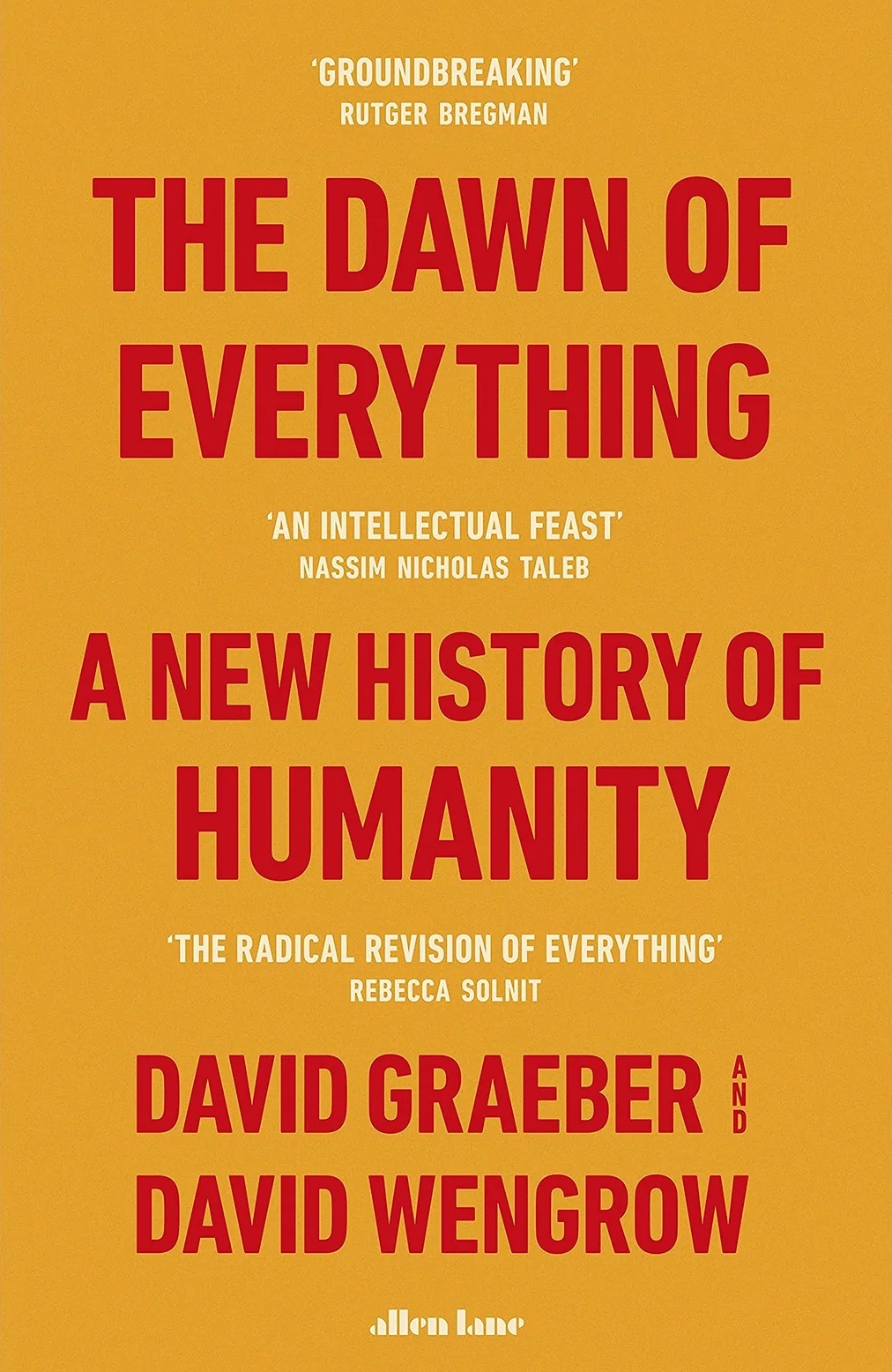
In The Dawn of everything I found a great deal of food for my confirmation bias. This is often a problem for me when I’m reading popular science writing, since my prejudices frequently seem to be in line with the results of statistical research, and the theorisations of researchers. When I’m reading humanities there’s usually more divergence, more moments when I think ‘but aren’t there a few other ways you could think about this?’ David Graeber and David Wengrow have written a book that feels like it was designed to make me feel good. I have a lot of ideas in my head about how societies could be ordered, how communities could be cultured. Why have we tried so few of the many possibilities, I often wonder. Why do we think we know something about social policy, when all the systems of social organisation we’ve tried are so bloody similar to each other? Graeber and Wengrow ask why we think we know what has been tried, and what its outcomes were. They ask why we think certain social and cultural features go with certain economic or ecologic strategies. They ask, for example, why we think urbanisation goes with hierarchy. The answer they come up with is, basically, that we have very thin evidence for the things we think about the development of human societies, and that there is compelling evidence that other things are in fact the case.
This is a hefty book, but it’s not a comprehensive one. The Davids look at exemplars, because to look at all the evidence in detail would have required many volumes. In fact they planned many books on related themes, but David Graeber sadly died in 2020, shortly before the publication of this book. Hopefully Wengrow will continue their work alone, or with other collaborators. The exemplars they are examine here are of two kinds. They examine the dominant models of human social development, and show that they are largely evolutionist and teleological, taking our current global society as an inevitable end point, or taking our end point as a starting point for their thinking. And they examine the anthropological and archaeological evidence that could cast some light on those models, showing that it mostly contradicts them. It’s a commonplace assumption that humans were egalitarian hunter-gatherers until some point in the neolithic, when we had something called the Agricultural Revolution, after which we had a surplus of food, and lived in complex, hierarchical societies. The Dawn of everything throws every aspect of this model into doubt. Agricultural societies did not produce more food, even per head or per hectare, prior to mechanisation. Many of the first cities show no signs of hierarchy. The earliest evidence for kings or rule by a warrior class comes from non-agricultural, non-urban societies. There are historical examples of societies that contradict the evolutionist model, such as the societies of Northern California and the Pacific Northwest. These people were all foragers, but they showed a wide range of social values in regard to egalitarianism, coercion, violence, slavery and so forth, none of which variation can be accounted for by the usual explanatory frameworks.
Most importantly, perhaps, Graeber and Wengrow examine the prevailing assumption that historical societies, and particularly forager societies, were the passive recipients of inherited political and cultural traditions, incapable of shaping their culture or politics intentionally. They give examples of members of such societies exercising rational agency with regard to the organisation of their communities, and ask why it is that such agency has been written out of historical accounts. Perhaps most strikingly, they ask what such peoples might have thought of Western European society, and they find a detailed Native American critique of our society hiding in plain sight in the historical record. Even more remarkably they make a compelling case for that critique as a major impetus for the intellectual revolution we refer to as the Enlightenment.
Clearly they wanted to find this stuff. One core insight, that there are many, many more possibilities than are admitted to in debates on social and economic policy, is one that I have long cherished as an anarchist, as someone who believes in a politics of choice and agency, of diverse communities organising themselves as suits their own unique circumstances. David Graeber was well-known as an anarchist activist, a leading light of the Occupy movement. His point of departure was likely to be closer to ‘there are many more ways of doing things than this’ than to ‘are there more ways of doing things than this?’ I’m sure that historians, archaeologists, anthropologists, economists and social theorists who don’t like their ideas will accuse them of cherry-picking the evidence. They’re clear throughout the book that they are being selective—if only because there is a limit to the size of manuscript their publisher would accept or their public would read. I’m not equipped to go and check their research in detail, but I’m reasonably confident that I’d be hearing about it by now if there were obvious holes in it, and I can certainly attest that it seems plausible. It has the shape and feel of rigorous scholarship, and it has that certainty or sure-footedness that comes from knowing it won’t be easy to poke holes in.
I have to hold some certainty in reserve however, because I really want them to be right. In fact, if I’m honest, I’m going to be acting as though they’re right. I’m going to building my own thoughts on theirs, and taking strength from the sheer volume of their scholarship. Why should I take the prevailing narratives seriously, when there is such a compelling, well-argued, thoroughly evidenced argument that they are bullshit? Human societies have come in all shapes and sizes, and there is nothing in the historical record to suggest that their current global form has any inevitability. Francis Fukuyama’s ludicrously hubristic claim for The End of history (1992) finally has a detailed rejoinder, as does Karl Marx’s rigidly linear and equally eschatological account of socio-economic succession. Of course I want to believe these Davids. Of course I will believe them, and given that my own work does not require me to excavate their scholarship, I’ll just put that last inch of certainty in abeyance, and build the rest of my intellectual life on this foundation. Few books have blown my mind or changed my thinking, but this is among the first rank of them.
 Oliver Arditi